
Computer Vision in Elite Sport: From Knowing Where a Player Is to Knowing How They Move

Prefer listening? Play the audio version:
This is the third deep-dive in our series on the technologies actually changing elite sport in 2026. Earlier deep-dives promised a closer look at computer vision; this is it. As ever, this is not a manual written from the touchline. It is a map of where the evidence is strong, where it is thin, and what a performance department should ask before letting any of it near a decision.
For most of the last decade, “tracking” in elite sport meant one thing: knowing where a player was. A single point on a pitch, a centre-of-mass coordinate at twenty-five frames a second, enough to compute distance covered, sprint counts and heat maps. That data reshaped how teams think about space and load, and in many elite environments it is now close to infrastructure. The shift that matters in 2026 is the move from position to pose, from knowing where a player is to capturing the angle of every joint, the asymmetry between limbs, the mechanics of every stride and jump, in three dimensions and without a single reflective marker. The promise is enormous: lab-grade biomechanics, on every athlete, every day, in the actual training environment rather than once a year in a gait lab. The reality, as with every technology in this series, is more conditional than the marketing, and the condition is a specific one worth understanding before you buy.
This piece makes one argument. The hardware and algorithms are now genuinely good enough to extract useful biomechanical variables from video, but only inside a narrow envelope: slower or more constrained movements, controlled lighting, fixed multi-camera setups, and purpose-built models. Step outside that envelope into fast, chaotic, ballistic competition with a generic model and limited cameras, and accuracy may not degrade gracefully; it can collapse. The frontier is real. Whether it is ready for your decisions depends almost entirely on how closely your use case sits to that controlled envelope. One clarification of scope before we start: this piece is about the performance-facing branch of computer vision, markerless pose estimation and biomechanical analysis. Tactical tracking, event detection, player identification, officiating and broadcast augmentation all matter, but they are not the question here.
Position tracking is mature. Pose is the harder problem.
It is worth being clear about what already works, because it sets up what does not. Optical and chip-based positional tracking, the kind that produces distance, speed and positional data, is mature enough in many elite team-sport environments that it has become close to infrastructure. The officiating world has industrialised it: Sony’s Hawk-Eye now drives automated and semi-automated decisions across tennis, cricket, football offside and, since 2025, NFL line-to-gain measurement via six 8K cameras (NFL, 2025). That is genuinely impressive engineering, but it is broadcast-and-officiating infrastructure, not performance science, and a head of performance can treat it as context rather than as a tool that changes a Monday-morning decision. The interesting question for performance is not where a player is. It is how they are moving while they get there, and that is a far harder computer-vision problem.
Pose in the lab: good, with asterisks
The premise of markerless motion capture is seductive. If a system can extract joint angles and limb trajectories from ordinary camera feeds, then biomechanical screening that once required a lab, reflective markers and a sports-science department could be done at scale, in the gym, on everyone. The foundational validation work shows this is partly true and partly oversold. In a controlled study using OpenPose with multiple synchronised cameras, Nakano and colleagues found that roughly 47% of joint-position errors fell under 20 mm and 80% under 30 mm, but around 10% exceeded 40 mm, often because the system briefly mistook one body segment for another (Nakano et al., 2020). That was two participants performing walking, jumping and throwing, in a controlled setting. It is a promising result and a cautionary one in the same breath: much of the time it can approach lab-level agreement for selected joint positions, and a meaningful slice of the time it is still wrong in ways that matter, hard to catch without the reference system you were trying to replace. That was two participants, in a controlled setting, on simple tasks; read it as a best case, not a field result.
A 2025 review from Auburn University’s Sport Biomechanics Lab put numbers on how wide that envelope really is across technologies. Markerless systems showed accuracy varying widely depending on the task, system and plane reported, from roughly 3 to 15 degrees in the sagittal plane these systems handle best, to 3 to 57 degrees in the transverse plane (Adlou et al., 2025). A 57-degree potential error on a rotational measurement is not a refinement issue; it is the difference between a usable number and noise. The honest reading is that markerless capture is most trustworthy for the slow, planar, gait-style movements it was largely trained and validated on, and least trustworthy for exactly the rotational, multi-planar, high-velocity actions that dominate real sport.
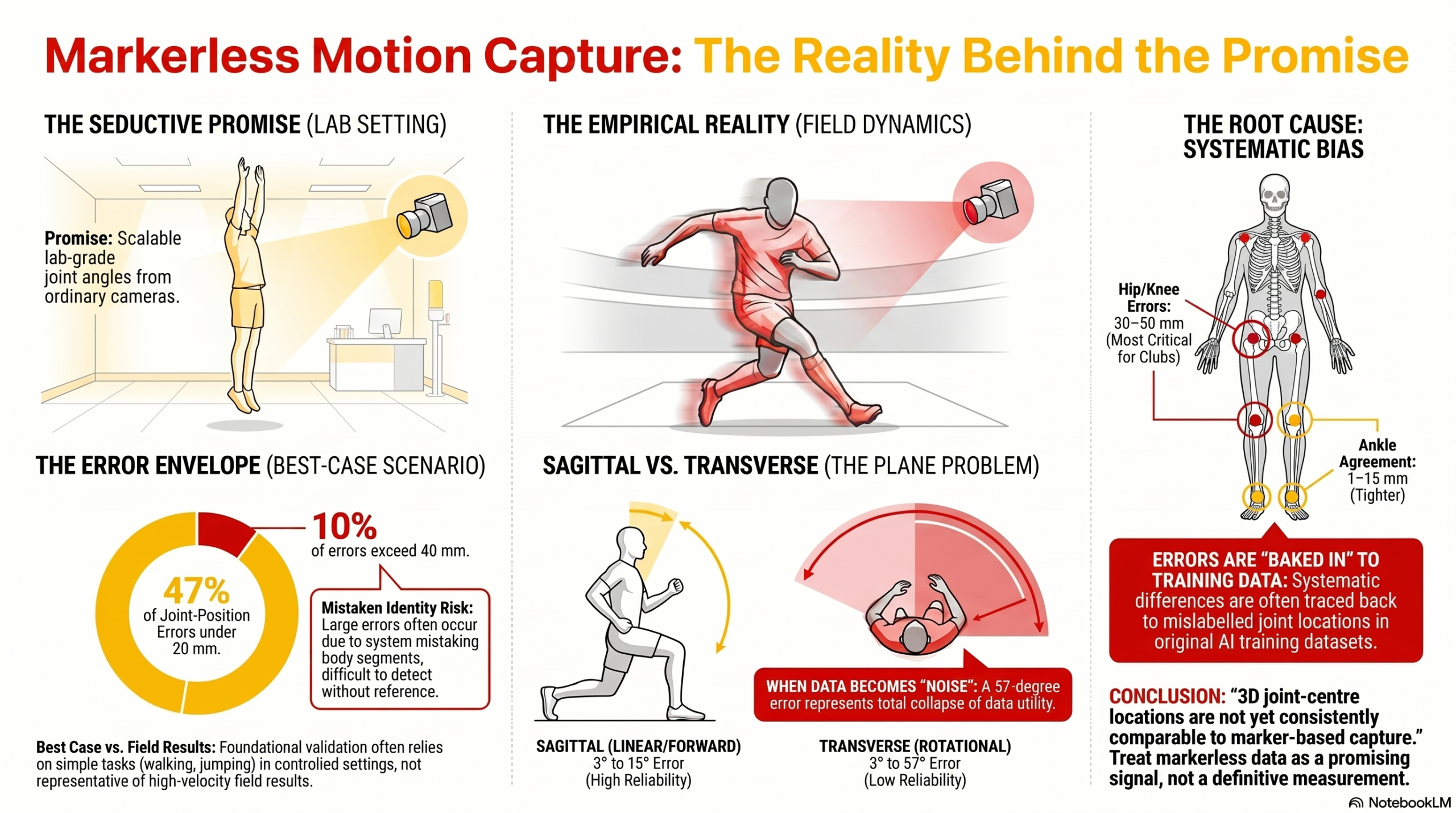
The most rigorous single study on where these errors come from is worth dwelling on, because it names the root cause. A team at the University of Bath’s motion-analysis centre compared three of the leading pose-estimation methods, OpenPose, AlphaPose and DeepLabCut, against marker-based motion capture across walking, running and jumping, with multi-camera high-speed imaging at 200 Hz (Needham et al., 2021). They found systematic differences of roughly 30 to 50 mm at the hip and knee for all three methods, traced not to the cameras but to mislabelled joint locations baked into the training data the models learned from. At the ankle, where that systematic labelling error was smaller, agreement tightened to 1 to 15 mm. Their conclusion is the sentence a performance director should tape to the monitor: markerless motion capture is highly promising, but 3D joint-centre locations are not yet consistently comparable to marker-based capture. The error is not random noise you can average away; it is a bias inherited from how the model was taught, and it sits precisely at the hip and knee, the joints most clubs care about most for lower-limb injury and asymmetry work.
Pose in competition: where it breaks, and where it doesn't
The most instructive evidence comes from one research group testing the same paradigm in two real competition settings, because it isolates what actually drives success. First, the failure. Cronin and colleagues tested OpenPose against manually digitised analysis at a real World Athletics long-jump competition, two cameras at 200 Hz, and found average agreement across take-off kinematics of just 0.17 on the intraclass correlation scale, poor by any standard.
Their conclusion was blunt: OpenPose is not suitable for in-competition performance analysis in events like the long jump (Cronin et al., 2024). An off-the-shelf pose estimator, trained on general human-movement images and given only two cameras, cannot resolve a ballistic athletic skill at competition speed.
Then, the success, from the same orbit of researchers. A 2026 study evaluated a purpose-trained markerless system, SIMI Nemo, on eight world-class pole vaulters at the 2024 World Athletics Indoor Championships in Glasgow, using a fixed four-camera setup at 100 Hz (Bissas & Cronin, 2026). This time the agreement with manual digitisation was strong for most spatial and centre-of-mass variables: mean relative bias of 0.3% and random error of 3.8%, with step length differing by about a centimetre. It was not uniform, joint angles at take-off agreed less well, with RMSE of 5 to 10 degrees, the authors noting the difficulty of identifying joint landmarks in field conditions. Same broad paradigm, same elite-competition setting, a far more favourable but still variable result. The variables that changed were the ones that always matter: a model purpose-trained on the sport rather than a generic one, and four dedicated cameras rather than two. That is the whole argument of this article in one comparison. The markerless paradigm is not the bottleneck. The training data and the camera configuration are.
What separates the systems that work
For a performance director, this reframes the buying question entirely. The question is not “does markerless motion capture work?”, it is “does this system, trained on movements like mine, with a camera setup like the one I can actually deploy, work for the specific decision I need it for?” A recent mini-review of commercial vision sensors and AI pose-estimation frameworks for sport makes the same point from the technology side: performance varies enormously with the framework, the sensor and the application, and general-purpose tools should not be assumed to transfer to specific sporting contexts (Edriss et al., 2025). The systems making genuine progress, in the SIMI tier and the bespoke-model tier, tend to be the ones built on sport-specific training data and controlled multi-camera rigs. The ones selling “biomechanics from any broadcast feed” are describing the capability that the long-jump study found wanting. The reference standard matters as much as the system. A tool validated against marker-based capture in a lab is not the same as one compared with manual digitising in live competition; both are legitimate, but they answer different questions, and a vendor citing one should not be allowed to imply the other.
The commercial direction is clear enough: more systems are moving from tracking outputs to movement-quality claims. The evidence says those claims are credible only when the use case, the camera setup and the validation target are every bit as specific as the claim itself.
There is a practical hierarchy a department can hold onto. Markerless screening in a controlled indoor setting, a return-to-play movement assessment, a jump-landing screen, a gait check, can be close enough to lab-grade to be genuinely useful today, provided you respect the planes it is weak in. In-training capture of fast field movements is promising and improving, but should be treated as indicative, not definitive, and validated against something before it drives a medical decision. And biomechanical analysis pulled from broadcast or single-camera footage of full-speed competition is, on the current evidence, not yet decision-grade for anything that matters clinically, whatever the demo shows. One more thing a practitioner would add: the strongest use case is rarely computer vision alone. It is computer vision integrated with force-plate data, training load, medical history and a coach’s eye, where movement data earns its place by explaining or challenging what the rest of the system is already seeing. Pose estimation does not compete with the rest of the performance stack; it is most useful when it is one more input into a picture the others are also painting. There is one more question that sits above all of these, and it is the one a practitioner asks first: how much precision does the decision actually need? Required accuracy is set by the decision, not by the vendor or the system. A five-degree error may be irrelevant for flagging a 15% inter-limb asymmetry in a return-to-play screen, and disqualifying for quantifying tendon load in a specific movement. A number is only as good as the decision it has to survive, and the same system can be decision-grade for one question and useless for the next. The buying test follows directly: what movement was the model trained on, how many cameras does it need and where, which planes and which variables are actually validated, what was the reference method, and what does the system do when it loses a joint behind another body? A vendor who can answer those crisply is worth the meeting; one who cannot is not yet selling a decision-ready capability.
The accuracy you can't see is the dangerous one
The specific danger with computer-vision biomechanics is different from the wearables problem we wrote about earlier in this series, and worth naming on its own. A readiness score at least announces that it is a soft composite. A markerless joint angle arrives looking like a hard measurement, a number, in degrees, on a skeleton overlaid on real video. It carries the authority of having been seen. But the errors documented across this literature share a quiet, treacherous property: the system does not flag the moments it gets wrong. It mislabels a segment, loses a joint behind another player, or inherits a 30-to-50-millimetre bias at the hip from its own training data, and produces a confident, wrong number with the same visual polish as a correct one. Worse, as the Bath study showed, some of that error is systematic rather than random, so you cannot even trust that averaging across many trials will wash it out. Without a reference you were trying to eliminate, you cannot tell the good numbers from the bad. That is the trap: a tool sold to replace the lab produces its most dangerous errors precisely when no lab is present to catch them.
So the position we would hold is this. Computer-vision biomechanics is one of the genuinely exciting frontiers in elite sport, and for controlled, planar, lower-speed assessment it is already good enough to change how departments screen athletes. But its accuracy is conditional in a way the marketing erases, and the conditions, purpose-trained models, controlled capture, respected planes of weakness, are often the ones a vendor demo makes easiest to overlook. Buy the capability for the envelope it has actually been validated in. Treat everything outside that envelope as a promising signal to verify, not a measurement to trust. The skeleton on the screen is not the athlete; it is a model’s best guess about the athlete, and the best guess is only as good as the camera that fed it and the data it was trained on.
How this series is made, and how to read it: this is editorial analysis, not a practitioner’s memoir and not a systematic review. PERFORM’s pieces are researched and drafted with the assistance of AI tools, then reviewed, edited and fact-checked by our editorial team against primary sources, peer-reviewed literature, clearly labelled preprints, industry reports, league and company announcements, and practitioners’ own published work. Where the evidence is strong we say so; where it is limited we treat it as limited; where a claim comes from a vendor or corporate announcement we treat it as a hypothesis, not proof. The views here are our editorial position, drawn from the published record rather than first-hand experience inside an elite performance department. Where practitioners are named or quoted, those words are their own. Where we couldn’t verify a claim, we left it out. And where you have the hands-on experience we’re writing about, we’d rather hear from you than pretend to it.
References
Adlou, B., Wilburn, C., & Weimar, W. (2025). Motion capture technologies for athletic performance enhancement and injury risk assessment: A review for multi-sport organizations. Sensors, 25(14), 4384. https://doi.org/10.3390/s25144384
Bissas, A., & Cronin, N. J. (2026). Evaluating markerless biomechanical analysis in a real-world pole vault competition setting. PLOS ONE, 21(3), e0329987. https://doi.org/10.1371/journal.pone.0329987
Cronin, N. J., Walker, J., Tucker, C. B., Nicholson, G., Cooke, M., Merlino, S., & Bissas, A. (2024). Feasibility of OpenPose markerless motion analysis in a real athletics competition. Frontiers in Sports and Active Living, 5, 1298003. https://doi.org/10.3389/fspor.2023.1298003
Edriss, S., Romagnoli, C., Caprioli, L., Bonaiuto, V., Padua, E., & Annino, G. (2025). Commercial vision sensors and AI-based pose estimation frameworks for markerless motion analysis in sports and exercises: A mini review. Frontiers in Physiology, 16, 1649330. https://doi.org/10.3389/fphys.2025.1649330
Nakano, N., Sakura, T., Ueda, K., Omura, L., Kimura, A., Iino, Y., Fukashiro, S., & Yoshioka, S. (2020). Evaluation of 3D markerless motion capture accuracy using OpenPose with multiple video cameras. Frontiers in Sports and Active Living, 2, 50. https://doi.org/10.3389/fspor.2020.00050
Needham, L., Evans, M., Cosker, D. P., Wade, L., McGuigan, P. M., Bilzon, J. L., & Colyer, S. L. (2021). The accuracy of several pose estimation methods for 3D joint centre localisation. Scientific Reports, 11, 20673. https://doi.org/10.1038/s41598-021-00212-x
NFL. (2025, April 1). Sony’s Hawk-Eye Innovations selected by the NFL to revolutionize line to gain measurements [Press release]. https://www.nfl.com/news/sony-s-hawk-eye-innovations-selected-by-nfl-to-revolutionize-line-to-gain-measurements