
Recovery and Sleep Tech in Elite Sport: Sorting the Science from the Spa
Prefer listening? Play the audio version:
This is the fourth deep-dive in our series on the technologies actually changing elite sport in 2026. As ever, this is not a manual written from the touchline. It is a map of where the evidence is strong, where it is thin, and what a performance department should ask before letting any of it near a decision.
Recovery is one of the areas in elite sport where the gap between what looks impressive and what is actually supported by evidence is especially wide. Walk through any elite training facility and you will see the hardware: cryotherapy chambers, pneumatic compression boots, percussion guns, red-light panels, temperature-controlled sleep pods. Much of it photographs beautifully and some of it works. The difficulty for a performance director is that the two categories overlap far less than the marketing implies, and telling them apart requires reading the evidence rather than the brochure. This piece tries to do that across the two halves of the recovery question: the physiological case for recovery as a genuine performance lever, and the technologies sold to improve it.
The argument in short: the science establishing that recovery matters is now strong and specific, stronger than most clubs act on. The science behind many of the devices sold to deliver that recovery is far weaker, and in at least one prominent case the most popular modality may quietly work against the adaptation an athlete is training for. The opportunity is to take recovery more seriously as a principle and the gadgets less credulously as a solution.
The part that is real: recovery is a performance lever, not a wellness add-on
Start with the strongest evidence, because it reframes everything downstream. A 2025 systematic review in the Journal of Strength and Conditioning Research examined the time course of physical impairment after professional soccer matches across thirteen studies (Drayton et al., 2025). Sprint, change-of-direction and technical ability had typically recovered by 72 hours. But vertical jump ability and hamstring strength were still significantly impaired at that 72-hour mark in multiple studies. The textbook assumption that a player is recovered two to three days after a match is, for the specific qualities that matter most to power output and lower-limb injury risk, often wrong. The 72-hour figure is best treated as a context-dependent heuristic rather than a universal law, the studies themselves show meaningful variation between players and protocols, but the direction is consistent enough to plan around. A caveat worth stating once: the strongest recovery evidence comes from professional soccer and comparable high-load team-sport environments, which are among the best studied. The principles travel, but the precise time courses do not transfer unaltered to every sport, and a practitioner should calibrate them to their own.
The mechanistic detail is even more pointed. Carmona and colleagues studied 20 professional soccer players across a match, with biceps femoris biopsies in 10 of them before and three days after (Carmona et al., 2024). Three days out, sprint performance and modifiable hamstring injury-risk factors had not fully recovered, with muscle-fibre disruption still visible on histology.
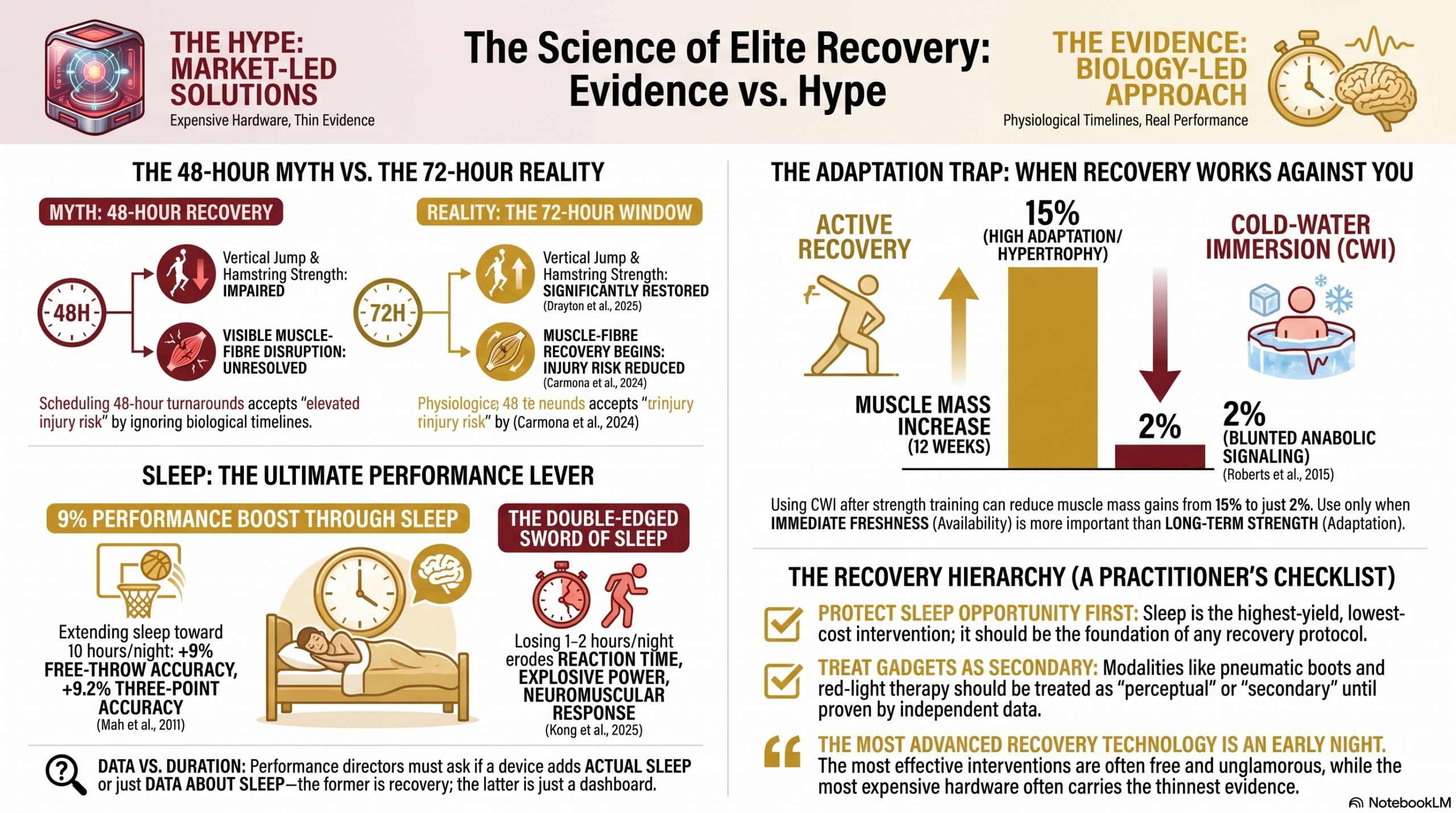
The blunt conclusion a performance director should draw is that a match impairs the hamstrings for at least 72 hours, and that congested fixture schedules built on 48-hour turnarounds are accepting elevated injury risk whether or not anyone has named it. This is the real case for taking recovery seriously, and it has nothing to do with any device. It is a scheduling and load-management argument first.
Sleep is the other half of the genuinely evidence-backed story, and it is likely the highest-yield recovery lever available to most teams, and certainly the most neglected relative to its cost, which is awkward because it is also the cheapest and least technological. The foundational study remains Mah and colleagues at Stanford, who extended basketball players’ sleep toward ten hours a night and recorded faster sprints, a 9% improvement in free-throw accuracy and a 9.2% improvement in three-point accuracy. It is a small study, eleven college players, and should be read as a seminal signal rather than definitive proof for every elite context (Mah et al., 2011). Those are not wellness numbers; they are performance numbers most technologies would never dare claim.
The implication is uncomfortable for a market built on hardware: the highest-return recovery intervention in sport is more time asleep, and most of what follows is a rounding error next to it.
The mirror image is just as well evidenced, and it is the part that should worry a performance director managing travel and fixture congestion. A 2025 meta-analysis of 45 studies found that sleep deprivation significantly degrades performance, with the largest effects on skill control and aerobic endurance (Kong et al., 2025). Even a chronic shortfall of one to two hours a night, the kind imposed routinely by night fixtures, long-haul travel and early media obligations, measurably erodes reaction time, explosive power and accuracy, and raises injury risk through slower neuromuscular response. Sleep is therefore the rare intervention with evidence running in both directions: extend it and performance rises, restrict it and performance falls. No device in this article can make that claim, and the cheapest fix in sport, protecting the athlete’s sleep opportunity, is likely to return more than many expensive modalities in most environments.
Sleep technology: useful, oversold, and not the same as sleep
If sleep is the lever, it helps to separate four things the market tends to blur: sleep as physiology (the adaptation that actually drives performance), sleep as measurement (tracking it), sleep as environment (shaping the conditions for it), and sleep as platform (the commercial layer sold on top). The technology sold around sleep divides into two honest categories and one murky one along exactly those lines. The honest categories are measurement and environment. Tracking sleep, as we covered in the wearables piece, is device- and metric-specific: consumer wearables are moderately accurate for total sleep time and night-to-night trend, weaker on wake-after-sleep-onset and sleep efficiency, and weakest on stage classification (light, deep, REM), where they still diverge meaningfully from polysomnography. Recent work in athletes also shows some smartwatches overestimate sleep duration and efficiency relative to actigraphy, by over two hours of total sleep time in one study of endurance athletes (Devrim-Lanpir et al., 2025), so the device and the comparison standard both matter before you trust a number. Environmental tools, temperature regulation in particular, have a plausible physiological basis: thermal comfort genuinely affects sleep onset and continuity. But plausibility is not proof, and here the honest caveat matters: a systematic review and meta-analysis of bedding and body-cooling strategies found no significant impact on sleep parameters, despite lowering core body temperature (Pasquier et al., 2025). Some athletes report sleeping better with a temperature-controlled surface, and that is worth something, but the synthesised evidence does not yet support selling it as a reliable physiological benefit.
The murky category is the leap from those modest, real benefits to the platform-scale claims now attached to sleep hardware: AI that models your sleep and optimises it, devices that promise an extra hour a night as a headline rather than a best case. A performance director should treat the venture-funded enthusiasm around sleep-as-platform the way we treated the biomarker frontier in the wearables piece, as a market signal rather than evidence. The question to put to any sleep-technology vendor is the one the Mah study implies:
Does this device add sleep an athlete would not otherwise get, or does it add data about sleep they were already getting? The first is valuable. The second is a dashboard.
The market is moving faster than the evidence
It is worth naming where the money is going, because the commercial momentum in this category is real even where the evidence is not yet. Temperature-regulating bed systems have attracted serious venture funding and a roster of elite-athlete users and investors across motorsport, tennis, basketball and endurance sport. A newer, more clinical generation of sleep technology is moving in alongside them: EEG-based headbands that deliver drug-free neurostimulation to guide the brain toward sleep, pitched explicitly as a non-pharmacological alternative to sleep medication, which matters in a sport context where pharmacological sleep aids carry residual-impairment and anti-doping complications. League-level interest in these tools is genuine, and the drug-free framing is a real advantage if the effect holds.
But a performance director should read all of this exactly as we read the biomarker frontier in the wearables piece: as a signal of where capital and ambition are moving, not as evidence that the tools have improved outcomes in elite sport. Athlete investors and league pilots are market validation, not clinical validation. The pilots reporting improved sleep onset and depth are promising and, so far, small, and a systematic review of sleep interventions in elite sport concludes that neurostimulation and neurofeedback remain among the least-established approaches, needing more reliable methods before firm conclusions (Bilgoe et al., 2025). At present this is a category for monitored pilots, not for broad procurement. The honest position is to watch it closely, demand independent data before deploying it squad-wide, and remember that the burden of proof sits with the vendor, not with the athlete asked to wear the device.
A note on data governance most clubs skip
There is a question underneath all sleep technology that the hardware conversation tends to skip: who sees the data, and what power does it carry? Sleep and recovery data is intimate. It reveals when an athlete went to bed, whether they slept badly before a contract negotiation, how they recover relative to teammates, and increasingly, through the biomarker and EEG layers, things that edge toward medical information. In an elite setting that data sits inside an employment relationship, which changes its character entirely. A readiness figure that informs a coaching decision is one thing; a longitudinal sleep record that could inform a selection or contract decision is another. The mature question is not only whether the technology works, but who is allowed to see what it produces, how it is stored, what consent it rests on, and whether an athlete can decline to wear it without consequence. At minimum, a club should define role-based access to the data, clear retention rules, a separation between medical and performance information, and explicit limits on its use in selection or contract decisions. Clubs that deploy sleep tech without answering those questions are accumulating a governance problem they have not noticed yet.
The modality stack: where the evidence gets thin
Beneath sleep sits the visible hardware of recovery, and here the evidence is genuinely mixed in a way the marketing rarely admits. Cold-water immersion is the instructive case because it is the most popular and the most studied. A 2023 meta-analysis in Frontiers in Physiology found that cold-water immersion does reduce markers of muscle damage and soreness, creatine kinase at 24 hours and perceived fatigue, but also that it reduces countermovement jump performance immediately afterwards, and that the subjective benefits are vulnerable to a substantial placebo effect (Xiao et al., 2023). In other words, ice baths make athletes feel recovered, which is not nothing, but the feeling and the performance do not always move together.
And then the finding that should genuinely change practice, because it is the clearest example in recovery science of a popular tool working against the athlete’s actual goal. Roberts and colleagues had resistance-trained men use cold-water immersion or active recovery after training for twelve weeks (Roberts et al., 2015). The cold-water group gained measurably less muscle mass and strength: quadriceps mass rose about 15% in the active-recovery group and only about 2% with cold-water immersion, with blunted anabolic signalling and satellite-cell activity to match. The mechanism is now well replicated. Cold water after strength training attenuates the adaptation the training was meant to produce. For an athlete in a hypertrophy or strength block, the ice bath is not neutral, it is counterproductive, and a performance department that schedules cold immersion indiscriminately after every session is quietly taxing its own strength work.
This is the single most important practical point in the recovery field, and it generalises into a principle. Recovery interventions that suppress inflammation, cold chief among them, can also suppress the inflammatory signalling that drives adaptation. The right question is therefore never just “does this aid recovery?” but “recovery toward what, and at what cost to the adaptation I am chasing?” Cold immersion is better understood as a tool with trade-offs than as good or bad.
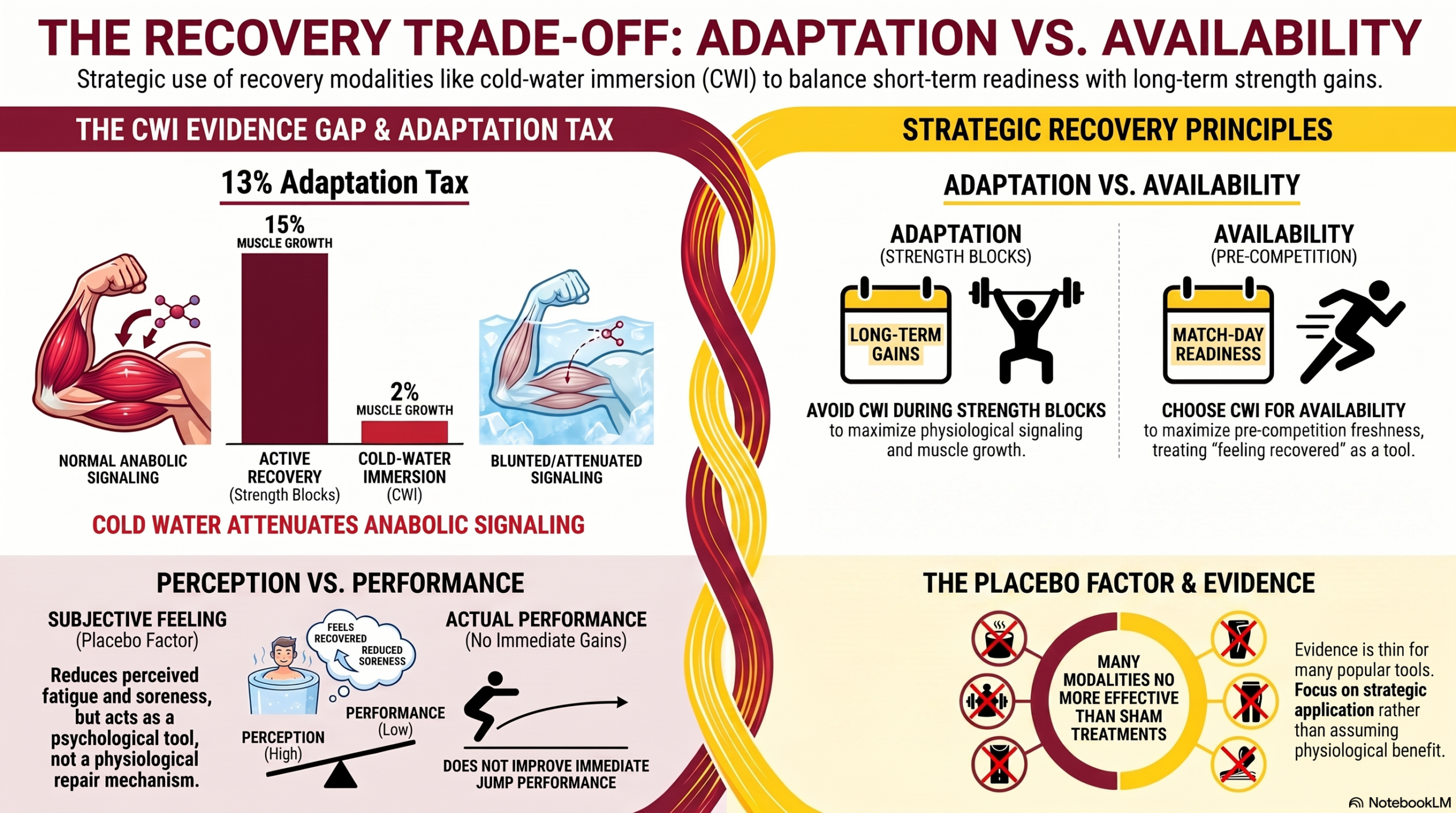
Its value depends on the primary objective (availability versus adaptation), the timing relative to the session, the frequency of use, the type of load, the time horizon, and the opportunity cost. Before a competition, where you want to feel fresh and there is no adaptation to protect, it is defensible. After a key strength session, repeated indiscriminately, it may quietly tax the very adaptation you are training for. Recent work in football has also found cold-water and hot-water immersion no better than a placebo sham treatment for post-match performance recovery or long-term training adaptation in national-level players (Gustafsson et al., 2025), which sharpens rather than softens the point: the intervention earns its place against a specific objective, or not at all.
The rest of the modality stack sits on a spectrum from modest evidence to mostly-perceptual benefit, and photobiomodulation, red and near-infrared light therapy, is the instructive middle case. An umbrella review of twelve systematic reviews found that light therapy does produce beneficial outcomes for exertion and recovery, particularly when applied before exercise, but that the quality of the underlying primary evidence is low and high-quality trials are still needed (Lawrence & Sorra, 2024). That is a fair summary of much of the modality stack: a real signal, wrapped in weak study designs, inconsistent doses and small samples, sold with a confidence the evidence has not earned. Pneumatic compression and percussion devices sit on weaker ground still: an umbrella review of recovery strategies in endurance sport found no strategy consistently advisable across contexts, with only scattered support for compression garments and cryotherapy on specific outcomes (Li et al., 2024). They are plausible, popular and pleasant, and the demonstrated effect on the performance qualities that matter remains thin, but the point is that each modality deserves its own evidence check rather than being waved through on category reputation.
Few of these are harmful, most produce a genuine subjective sense of recovery, and none is the silver bullet its category marketing implies. The honest synthesis is that the best-resourced clubs deploy several modalities in combination, individualised to the athlete and the phase of the season, and treat the subjective recovery benefit as worth something in its own right without confusing it with a proven physiological one. Feeling recovered has real value: it affects mood, confidence, willingness to train and adherence, and the placebo and expectation literature in sport shows pooled effects of moderate to large magnitude, not trivial ones (Chhabra & Szabo, 2024). Perceptual mechanisms are not fake effects; they are real effects with a different causal architecture. The discipline a performance director needs is to measure and price them as such, crediting the genuine benefit without attributing to a modality a physiological mechanism it has not demonstrated.
Take the principle seriously, take the hardware sceptically
The recovery field inverts the usual relationship between evidence and spend. The interventions with the strongest evidence, more sleep, smarter scheduling around the real 72-hour recovery curve, careful timing of when not to suppress inflammation, are largely free and largely unglamorous. The interventions with the heaviest marketing and the highest capital cost, the chambers and pods and boots, carry the thinnest evidence and, in the case of indiscriminate cold exposure, a real risk of working against the training. That inversion is the whole story, and it is the opposite of how most recovery budgets are allocated.
So the position we would hold is this. Recovery is a genuine performance lever, and the science establishing that is now strong enough that ignoring it is a competitive error. But the technology sold to deliver recovery should be bought with more scepticism than almost any other category in this series, because here the subjective feeling of benefit is so strong that it substitutes for evidence rather than demanding it. Before buying the chamber, fund the sleep. Before scheduling the ice bath, ask what adaptation you might be washing away. And measure recovery interventions against the only standard that matters: not whether the athlete feels recovered, but whether the quality you actually care about, jump, sprint, strength, returns faster because of it. For most clubs, the highest-return recovery intervention remains better sleep opportunity and smarter scheduling, and the gap between knowing that and acting on it is where the real margin lives. Put less analytically: the most advanced recovery technology in most clubs is still an early night. Before that, the question a department should actually run each modality through, because “does it aid recovery?” is too blunt to be useful. Name the primary objective first: availability for the next match, long-term adaptation, analgesia, sleep, or compliance, because an intervention that serves one can undermine another. Then the time window: same day, under 24 hours, the 48-to-72-hour block, or across a training phase.
Then the critical endpoint you will actually measure, whether that is jump, sprint, hamstring torque, total sleep time or soreness, or whatever performance-limiting quality is most decision-relevant in that sport and phase, not a generic sense of recovery. Then the honest level of evidence behind it: strong, moderate, weak, or vendor-only. And finally the full cost: not just the purchase price but athlete burden, staff time, friction, and the governance risk of the data it generates. A modality that clears those questions is worth deploying; one that survives only on perceived benefit belongs in a trial or an n-of-1, not a squad-wide protocol. If the whole article reduced to an operating order, it would be this: protect sleep before anything else, schedule around the real 72-hour recovery curve rather than the textbook 48, avoid immediate post-strength cold immersion as a default in hypertrophy or strength phases, reserving it for cases where next-session availability outweighs the adaptation cost, treat the visible gadgets as secondary and perceptual until proven otherwise, and settle the data-governance question before you buy the hardware, not after.
How this series is made, and how to read it: this is editorial analysis, not a practitioner’s memoir and not a systematic review. PERFORM’s pieces are researched and drafted with the assistance of AI tools, then reviewed, edited and fact-checked by our editorial team against primary sources, peer-reviewed literature, clearly labelled preprints, industry reports, league and company announcements, and practitioners’ own published work. Where the evidence is strong we say so; where it is limited we treat it as limited; where a claim comes from a vendor or corporate announcement we treat it as a hypothesis, not proof. The views here are our editorial position, drawn from the published record rather than first-hand experience inside an elite performance department. Where practitioners are named or quoted, those words are their own. Where we couldn’t verify a claim, we left it out. And where you have the hands-on experience we’re writing about, we’d rather hear from you than pretend to it.
References
Bilgoe, S. C., den Hollander, S., Janse van Rensburg, D. C., Hendricks, S., Kerkhoffs, G., & Gouttebarge, V. (2025). Sleep interventions in elite sport: A systematic review. South African Journal of Sports Medicine, 37(1), a18811. https://doi.org/10.17159/2078-516X/2025/v37i1a18811
Carmona, G., Moreno-Simonet, L., Cosio, P. L., Astrella, A., Fernández, D., Cadefau, J. A., Rodas, G., Jou, C., Milisenda, J. C., Cano, M. D., Arànega, R., Marotta, M., Grau, J. M., Padullés, J. M., & Mendiguchia, J. (2024). Hamstrings on focus: Are 72 hours sufficient for recovery after a football (soccer) match? A multidisciplinary approach based on hamstring injury risk factors and histology. Journal of Sports Sciences, 42(12), 1130–1146. https://doi.org/10.1080/02640414.2024.2386209
Chhabra, B., & Szabo, A. (2024). Placebo and nocebo effects on sports and exercise performance: A systematic literature review update. Nutrients, 16(13), 1975. https://doi.org/10.3390/nu16131975
Devrim-Lanpir, A., Devenney, S., & Egan, B. (2025). Evaluation of the agreement between research-grade actigraphy sleep, consumer-grade smartwatches and self-reported sleep diaries in masters endurance athletes. Journal of Sleep Research, 34(6), e70177. https://doi.org/10.1111/jsr.70177
Drayton, A. M., Hamad, M. J., & Spyrou, K. (2025). The time course of postmatch physical impairments in professional soccer: A systematic review. Journal of Strength and Conditioning Research, 39(11), e1345–e1355. https://doi.org/10.1519/JSC.0000000000005252
Gustafsson, J., Montiel-Rojas, D., Romare, M. G. A., Johansson, E., Folkesson, M., Pernigoni, M., Frolova, A., Brazaitis, M., Venckunas, T., Ponsot, E., Chaillou, T., & Edholm, P. (2025). Cold- and hot-water immersion are not more effective than placebo for the recovery of physical performance and training adaptations in national level soccer players. European Journal of Applied Physiology, 125, 3179–3194. https://doi.org/10.1007/s00421-025-05835-w
Kong, Y., Yu, B., Guan, G., Wang, Y., & He, H. (2025). Effects of sleep deprivation on sports performance and perceived exertion in athletes and non-athletes: A systematic review and meta-analysis. Frontiers in Physiology, 16, 1544286. https://doi.org/10.3389/fphys.2025.1544286
Lawrence, M. M., & Sorra, K. (2024). Photobiomodulation as medicine: Low-level laser therapy (LLLT) for acute tissue injury or sport performance recovery. Journal of Functional Morphology and Kinesiology, 9(4), 181. https://pmc.ncbi.nlm.nih.gov/articles/PMC11503318/
Li, S., Kempe, M., Brink, M., & Lemmink, K. (2024). Effectiveness of recovery strategies after training and competition in endurance athletes: An umbrella review. Sports Medicine – Open, 10(1), 55. https://doi.org/10.1186/s40798-024-00724-6
Mah, C. D., Mah, K. E., Kezirian, E. J., & Dement, W. C. (2011). The effects of sleep extension on the athletic performance of collegiate basketball players. Sleep, 34(7), 943–950. https://doi.org/10.5665/SLEEP.1132
Pasquier, F., Chauvineau, M., Castellini, G., Gianola, S., Bargeri, S., Vitale, J., & Nedelec, M. (2025). Does body cooling facilitated by bedding compared to control condition improve sleep among adults (18–64 years old)? A systematic review and meta-analysis. Journal of Thermal Biology, 127, 104030. https://doi.org/10.1016/j.jtherbio.2024.104030
Roberts, L. A., Raastad, T., Markworth, J. F., Figueiredo, V. C., Egner, I. M., Shield, A., Cameron-Smith, D., Coombes, J. S., & Peake, J. M. (2015). Post-exercise cold water immersion attenuates acute anabolic signalling and long-term adaptations in muscle to strength training. The Journal of Physiology, 593(18), 4285–4301. https://doi.org/10.1113/JP270570
Xiao, F., Kabachkova, A. V., Jiao, L., Zhao, H., & Kapilevich, L. V. (2023). Effects of cold water immersion after exercise on fatigue recovery and exercise performance: A meta-analysis. Frontiers in Physiology, 14, 1006512. https://doi.org/10.3389/fphys.2023.1006512