
The Hottest World Cup: How Teams Prepared for the Heat of 2026, and What Is Happening Now It's Here

Prefer listening? Play the audio version:
Part of our series on the science and technology shaping elite athlete performance in 2026.
Unlike most pieces in this series, this one is a live case study, written from inside the tournament: as we publish, the 2026 World Cup has reached its quarter-finals, in the hottest weeks of the North American summer, the most intense moment of the competition, both literally and metaphorically. As ever, this is not a manual written from the touchline. It is a map of what teams did to prepare, what the science says about it, and what is happening now, in real time, as that preparation meets the conditions.
The 2026 World Cup, hosted across the United States, Mexico and Canada, was always going to be a physiological event as much as a footballing one.
Played through June and July across sixteen cities and multiple climate zones, it puts heat, humidity, altitude, travel and sleep disruption at the center of the competition. This is the tournament that has turned environmental preparation from a specialist concern into a headline. And right now, as the quarter-finals arrive under a heat dome that has pushed temperatures past 38°C (and toward 43°C in several host cities), we are watching the science, and the preparation, collide with reality in front of us. This article looks at what teams did to get ready, grounds those preparations in the evidence, and, because the tournament is at its peak as we write, examines what is actually happening as the heat bites.
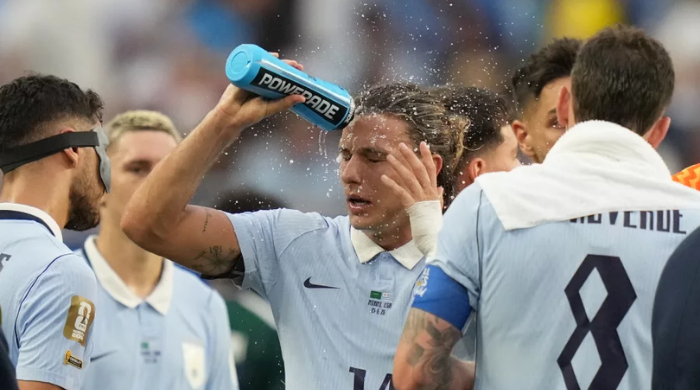
Uruguay’s Agustin Canobbio cools off during a hydration break in a World Cup soccer match against Saudi Arabia in Miami Gardens, Fla., on Monday. Dangerously hot, humid weather in the area prompted an extreme heat warning from the National Weather Service earlier in the day. Lynne Sladky/AP
The Scale of the Challenge Was Known Well In Advance
The warnings were specific and early. Research led by Queen’s University Belfast flagged that the wet-bulb globe temperature in certain host cities would exceed that of Qatar in winter and urged FIFA to schedule kickoffs later in the day (as reported across tournament coverage). Climate analysis suggested this could be among the hottest World Cups on record, with roughly a quarter of matches at risk of being played in genuinely hot conditions and a handful of dangerous ones.
An independent Climate Central analysis went further, estimating that 97 of the 104 matches would carry an elevated likelihood of performance-impairing heat, with that threshold set at around 28°C, the point at which players’ running output measurably declines.
The precedent was fresh. At the 2025 FIFA Club World Cup, also held in the United States, players and coaches had already complained about the physical toll of extreme heat, with several matches reporting temperatures in the 32-39°C range and weather delays. The 2026 tournament was walking into conditions that had visibly troubled elite players a year earlier.
Two additional environmental factors sat alongside the heat. Matches in Guadalajara (around 1,566 m) and Mexico City (around 2,240 m) added moderate altitude, with its familiar penalty on high-intensity capacity. And the sheer geographic spread of the tournament (sixteen cities, three countries, multiple time zones, and kickoff times ranging from noon to midnight Eastern) made travel and sleep disruption a genuine performance variable rather than a footnote.
What The Teams Did
England: the most methodical, and the most public
England’s preparation was the most openly documented and the most technology-driven. Ahead of the tournament, at a warm-weather camp in Girona, Spain, the team erected specially heated pitchside tents with the internal temperature artificially raised and put players through bike work inside them while their individual recovery was monitored, ESPN reported.
The approach reflected manager Thomas Tuchel’s data-driven method, and Tuchel himself was strikingly candid about what lay ahead, stating: “I will be very surprised if we do not suffer. Suffering is one of the headlines for this World Cup”. England’s preparation extended beyond heat into sleep. The team reportedly brought customized “sleep kits” to its Kansas City base, including mattress toppers tailored to each player’s body type and cooling pillows intended to offset heat and humidity, according to CNN. This detail matters because, as this series has covered, sleep is among the most strongly evidenced recovery levers available, and a tournament spread across time zones with late kickoffs directly threatens it.
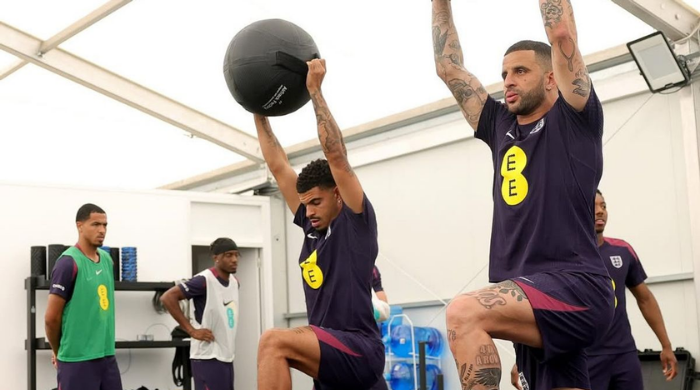
The England national team is conducting a training camp with temperature adjustment at the 2026 World Cup (Instagram/@england).
Others: ice collars, and the visible strain
Other teams revealed their methods in more improvised ways. Norway’s players wore ice collars around their necks during a pre-tournament friendly against Morocco, a simple, evidence-consistent cooling strategy. And the strain was visible before the tournament even began: images of European players, unaccustomed to the heat, dousing themselves with water and lying on the pitch during training circulated widely, a preview of the physiological gap between teams from cooler and hotter climates.
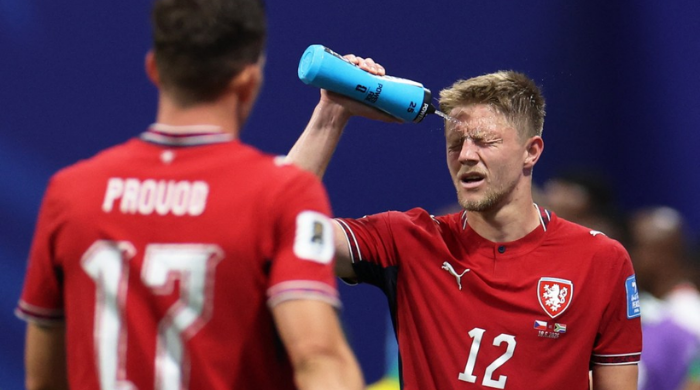
Pictured: Lukas Cerv of team Czech Republic. REUTERS
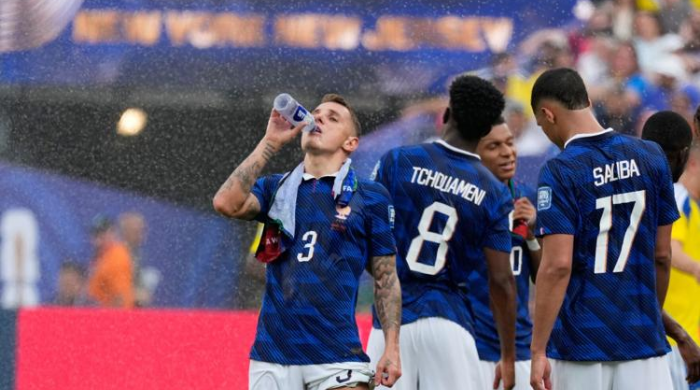
France’s Lucas Digne cools during the hydration break during the World Cup. Seth Wenig – AP
The equipment layer: cooling technology goes mainstream
The most visible technological response came from the kit itself. Adidas equipped its fourteen World Cup partner federations with a three-piece system it calls CLIMACOOL, adapted from cooling gear originally developed for Mercedes-AMG Petronas Formula 1 drivers. A pre-frozen gel vest worn over the shirt cools the torso; an airproof insulating jacket worn on top traps the cold to roughly double the effect; and a gel overshoe drops foot temperature by around 2°C in seven minutes before being removed for play. Adidas claims the vest-and-jacket pairing can lower core temperature by up to 0.5°C and skin temperature by as much as 13°C, figures aimed squarely at the pre-cooling and half-time windows the science prioritises.
England layered instrumentation on top of the acclimation work. ESPN reported that, alongside the heated Girona tents, the Football Association had players swallow ingestible digital capsules to read core temperature directly, fitted them with Whoop monitors to log how each individual responded to sessions, and introduced high-carbohydrate liquid hydration pouches designed specifically for the mandated in-play breaks. The common thread is measurement: rather than guessing how a squad copes with heat, teams are now instrumenting the response player by player.
The Science Behind the Preparation
Every one of these interventions maps onto a well-established evidence base, which is what separates genuine preparation from theatre.
Heat acclimation is the foundation. The standard protocol, as described by Loughborough University environmental physiologist Dr Matt Maley, involves exercising in hot conditions for roughly 10 consecutive days, producing well-documented adaptations: an increased sweat rate, lower resting and exercising core temperature, and a reduced heart rate for the same workload. Maley also identified the relevant threshold: meaningful performance decrements begin to appear at a wet-bulb globe temperature of around 26°C, though this varies with intensity and the individual. England’s heated tents were, in effect, a way of delivering this acclimation stimulus during a training camp when the local climate would not.
The honest caveat, which the physiologists themselves stressed, is that acclimation shifts the risk curve without eliminating it. It buys lower core temperatures and heart rates at a given workload, but it does not make players “heat-proof,” particularly across a 39-day tournament with heavy travel and limited recovery.
Cooling strategies (the ice collars, cooling pillows, and the pre-cooling and half-time cooling that teams planned) rest on the principle that lowering body temperature before and during exertion delays the point at which heat begins to degrade performance and threaten health. But, as a Scientific American analysis of the cooling toolkit pointed out, the evidence is not uniform. Interventions that cover a large skin surface area, such as cooling vests and cold-water immersion, have the strongest support for actually lowering core temperature, whereas ice towels and cold packs chilling a small patch of skin do more for perceived comfort than for core cooling, and their evidence base is thin. A department buying cooling equipment is also buying, implicitly, a claim about mechanism, and those claims are not equally well founded.
Sleep and routine management complete the picture. The most useful principle here, articulated by former Aston Villa physiotherapist Dominic Rae, is to preserve familiar routines above all: keep the player’s usual dinner time, meeting schedule, and even the specific pillow they used all season, rather than disrupting a pattern the body has held for ten months. England’s individualized sleep kits are an application of exactly this thinking. There is also a less obvious travel cost: long flights and cabin pressure increase dehydration and can cause injured players’ joints to swell, another variable a congested, continent-spanning tournament forces teams to manage.
FIFA's Institutional Response: Mandatory Cooling Breaks
Beyond what individual teams did, the tournament itself is structured around the heat. For the first time in men’s World Cup history, FIFA has mandated three-minute hydration breaks in each half of every match, at roughly the 22-minute mark, regardless of weather, roof or air conditioning, a decision it says is intended to “ensure equal conditions for all teams, in all matches,” drawing on the experience of the sweltering 2025 Club World Cup. As the knockout heat intensified, FIFA president Gianni Infantino defended the measure as fundamentally about player safety in extreme conditions, rejecting the suggestion that the pauses exist to create advertising inventory.
The blanket application is proving contentious in a way that is itself revealing about the science. Netherlands captain Virgil van Dijk questioned applying the rule uniformly after a match played in air-conditioned conditions: “Hydration breaks are a bit interesting. If it’s really hot, obviously it would be good to put them in. But I think you have to look at it in every game, separately”.
United States coach Mauricio Pochettino makes the same point: “I only like it when the conditions are extreme. When the conditions are good, it is unnecessary”. A group of medical and public-health professionals, meanwhile, argues from the opposite direction, that three minutes is too short to meaningfully aid rehydration and cooling, and should be extended to six. The disagreement captures a genuine tension: cooling breaks are a real intervention with real tactical and physiological consequences, and the right dose is contested.
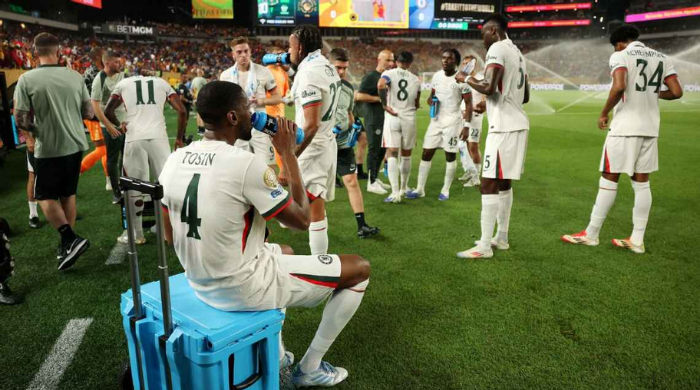
France’s Lucas Digne cools during the hydration break during the World Cup. Seth Wenig – AP
What Happened When Preparation Met Reality
Here the case study becomes most instructive, because the tournament is testing the preparation directly, in front of us, and what we are seeing aligns closely with what the physiologists predicted. We are now in the quarter-finals, in the hottest weeks of the summer, and this is where both the football and the conditions reach their most intense.
The heat is visibly shaping play. Brazil forward Vinícius Júnior described its tactical effect plainly after an early draw with Morocco: “In the second half, with the heat, the pitch dries out very quickly. The game becomes very sluggish, and we can’t get into our rhythm”. This is precisely the mechanism the science predicts: as core temperature rises and the body prioritises cooling, high-intensity output falls and the game slows.
And as the knockout rounds have progressed, the conditions have not eased: they have escalated. A heat dome settling over the eastern United States and Canada drove the round-of-16 match between France and Paraguay in Philadelphia into what forecasters flagged as potentially the hottest, most dangerous game of the entire tournament, with temperatures around 39°C and a heat index approaching 43°C. France won it 1-0, settled, tellingly, by a single Kylian Mbappé penalty in a match the conditions had slowed to a crawl.
The cooling kit is already visible in matches, not just training. During one sweltering goalless group-stage draw in Miami, Colombia’s players pulled on ice vests at the hydration breaks while Portugal’s reached for chilled neck collars, the CLIMACOOL system and its low-tech cousins pressed into service exactly when the conditions demanded.
Tuchel’s framing is holding up against reality in an interesting way. Despite his pre-tournament candor about suffering, now the matches are under way he refuses to change England’s style, insisting: “I’m just not ready to adapt into a different style of football because of circumstances that we cannot influence”, while still acknowledging the heat has affected training at England’s Kansas City base. England captain Harry Kane, for his part, downplayed the heat’s likely impact after heading home the winner in a warm-weather friendly against New Zealand in Tampa, played in 33°C, insisting the squad’s preparation meant the conditions “won’t be a factor”. The contrast between Tuchel’s “we will suffer,” Kane’s “it won’t be a factor,” and Vinícius’s “the game becomes very sluggish” is the whole debate in three quotes: preparation helps, confidence varies, and the heat still shapes the football.
The heat is not flattening everyone equally, and that unevenness is itself part of the story. Even as matches slow, the tournament’s standout attacking performances continue. The Golden Boot race arrives at the quarter-finals as close as any in memory: Lionel Messi leads with eight goals, having broken a three-way tie at the top with his equaliser in Argentina’s dramatic round-of-16 comeback against Egypt, with Mbappé and Erling Haaland one behind on seven and Harry Kane on six. This is a useful corrective to any simple narrative that heat reduces all football to attrition.
The conditions raise the physiological cost of high-intensity output for everyone, but the highest-quality players are still finding ways to be decisive within a slower game: Messi scoring the equaliser and setting up another as Argentina scored three times in the final thirteen minutes to escape a two-goal hole against Egypt, Haaland’s brace sinking Brazil, Mbappé’s penalty settling France in the Philadelphia furnace. This is exactly what the science would predict, since heat degrades sustained high-intensity running more than it degrades the brief, efficient moments of quality that separate elite attackers. Preparation and conditions shape the average; individual quality still decides matches.
The institutional response is now visible in the fixture list itself. Both semi-finals have been scheduled into retractable-roof, air-conditioned stadiums, Dallas on 14 July and Atlanta on 15 July, an explicit choice to shield the tournament’s decisive matches from the peak of the summer heat. Scheduling, in other words, has become its own cooling strategy: the same logic as an ice collar, applied at the level of the calendar.
The cooling breaks are also influencing matches tactically, exactly as anticipated. Former England striker Alan Shearer observed that a hydration break appeared to swing momentum in one match, allowing a team to absorb pressure and recover. A welfare measure, in other words, is becoming a tactical variable, a reminder that in elite sport, no intervention stays confined to its intended purpose.
The Position A Department Can Hold
The 2026 World Cup is, as it unfolds, the clearest real-world demonstration this series has of a recurring theme: good preparation is genuine and worthwhile, and it still does not overcome physics.
The lessons that generalize are these. Environmental preparation works and is worth doing thoroughly: heat acclimation over roughly ten days produces real, measurable adaptations, and the teams that prepared methodically (England’s tents and sleep kits being the clearest example) did so on solid evidence. Cooling strategies and disciplined sleep-and-travel routines are low-cost, evidence-supported, and worth the effort.
But preparation shifts the risk curve rather than removing it: even well-prepared elite players are slowing down in the extreme heat, as we have seen from the Philadelphia round-of-16 furnace onward, and no acclimation protocol makes a squad heat-proof across a month of travel and congested fixtures. Institutional interventions (mandatory cooling breaks, and now the deliberate placement of the semi-finals under closed roofs) are real variables with tactical consequences, not neutral pauses, and their optimal design is genuinely contested. And the honesty of a coach like Tuchel, preparing meticulously while openly expecting to suffer, is the correct posture: do everything the evidence supports, and hold no illusion that it makes the conditions disappear.
As the quarter-finals play out in the hottest weeks of the summer, the tournament is telling performance departments something this series keeps returning to. The science is real and worth applying rigorously. It is not magic, and right now, live and in the heat, we are watching exactly where that line sits.
How this series is made, and how to read it: this is editorial analysis, not a practitioner’s memoir and not a systematic review. PERFORM’s pieces are researched and drafted with the assistance of AI tools, then reviewed, edited and fact-checked by our editorial team against primary sources, peer-reviewed literature, clearly labelled preprints, industry reports, league and company announcements, and practitioners’ own published work. Where the evidence is strong we say so; where it is limited we treat it as limited; where a claim comes from a vendor or corporate announcement we treat it as a hypothesis, not proof. The views here are our editorial position, drawn from the published record rather than first-hand experience inside an elite performance department. Where practitioners are named or quoted, those words are their own. Where we couldn’t verify a claim, we left it out. And where you have the hands-on experience we’re writing about, we’d rather hear from you than pretend to it.
References
Al Jazeera. How extreme weather and heat could affect players at World Cup 2026. https://www.aljazeera.com/sports/2026/6/8/how-extreme-weather-and-heat-could-affect-players-at-world-cup-2026
Al Jazeera. How the North American heatwave could impact the FIFA World Cup. https://www.aljazeera.com/news/2026/7/2/how-the-north-american-heatwave-could-impact-the-fifa-world-cup
Climate Central. 2026 World Cup: Climate change boosts performance-impairing heat at nearly every match. https://www.climatecentral.org/climate-matters/world-cup-matches
CNN. Why heat, travel and sleep could challenge teams as much as the opposition at the World Cup. https://www.cnn.com/2026/06/07/sport/world-cup-heat-travel-rest-challenges
E&E News / POLITICO. A 3-minute timeout ignites World Cup’s hottest debate. https://www.eenews.net/articles/a-3-minute-timeout-ignites-world-cups-hottest-debate/
ESPN. England players take heat-tracking capsules in World Cup preparation. https://www.espn.com/soccer/story/_/id/45456445/england-players-take-heat-tracking-capsules-world-cup-prep
ESPN. England train in tents to mimic 2026 World Cup heat. https://www.espn.com/soccer/story/_/id/45440232/england-train-tents-mimic-2026-world-cup-heat-sources
ESPN. Inside England’s World Cup prep: Tuchel’s squad survive storms, heat in Florida. https://www.espn.com/soccer/story/_/id/49029911/inside-england-world-cup-prep-thomas-tuchel-squad-survive-storms-heat-florida
ESPN. Summer heat ‘won’t be a factor’ for England at World Cup: Harry Kane. https://www.espn.com/soccer/story/_/id/48991196/summer-heat-factor-england-world-cup-harry-kane
Inside World Football. England take high-tech approach to heat acclimatisation ahead of 2026 World Cup. https://www.insideworldfootball.com/2025/06/05/england-take-high-tech-approach-heat-acclimatisation-ahead-2026-world-cup/
Loughborough University. England’s toughest challenge at the 2026 World Cup might not be another team: it could be the heat. https://www.lboro.ac.uk/media-centre/press-releases/2026/june/england-world-cup-heat-impact-performance/
Scientific American. Which World Cup cooling methods really protect players from extreme heat? https://www.scientificamerican.com/article/world-cup-is-battling-extreme-heat-which-cooling-methods-really-work/
Sky Sports. World Cup 2026 Golden Boot race: Messi, Mbappé, Kane and Haaland in epic battle. https://www.skysports.com/football/news/12098/13556951/
Sportico. World Cup knockout teams will face the ultimate foe: heat wave. https://www.sportico.com/leagues/soccer/2026/world-cup-heat-forecast-temperatures-hydration-breaks-rules-1234937506/
Vanguard. World Cup: Tuchel, Vinicius, others raise concern over heat, cooling breaks. https://www.vanguardngr.com/2026/06/world-cup-2026-tuchel-vinicius-others-raise-concern-over-heat-cooling-breaks/
Washington Post. Eastern heat on July 4 threatens World Cup players and fans. https://www.washingtonpost.com/sports/soccer/2026/07/03/world-cup-soccer-extreme-heat-athletes/