
The Longevity Question: What Actually Keeps Elite Athletes at the Top for Longer

Prefer listening? Play the audio version:
Across several major sports, the visible trend is toward longer careers at the top. Athletes are competing at elite level into their mid-thirties and beyond in numbers that would have been unusual a generation ago. The natural question for a performance department is causal: what is driving this, and how much of it can be deliberately engineered? The honest answer requires separating what the evidence supports from what is merely plausible, and resisting the temptation to attribute a complex, multi-factor trend to whichever intervention a department happens to be selling or buying. Longevity is the ultimate test of a performance programme, and precisely because it is, it is the claim most vulnerable to being sold on correlation dressed as cause.
Performance has an age curve, and it is position-specific
Any serious discussion of longevity has to start with the underlying shape of athletic decline, because longevity is best understood as deviation from an expected curve rather than as an absolute number. An athlete performing at 34 is only remarkable relative to what their position and sport would predict.
Modelling of football performance using generalized additive models gives a concrete version of that curve. In an analysis of Swedish top-flight players, overall peak performance was estimated to fall between roughly 25 and 27, with meaningful variation by position: forwards tended to peak earliest, around 25, defenders and midfielders across the 25 to 27 band, and goalkeepers by around 27 (Säfvenberg et al., 2024). More important than the peak ages is the shape of the decline after them: the drop-off was found to be steepest for forwards and midfielders, while defenders and goalkeepers showed a longer, slower, more gradual decline. The peak is only half the story; the slope on the far side of it is the half that governs how long a career can last.
The practical implication is that longevity means different things for different roles. A goalkeeper performing at elite level at 35 is much closer to the expected curve than a forward doing the same, and conflating the two obscures more than it reveals. A department thinking seriously about extending careers has to anchor that thinking to the position-specific curve, not to a single notion of peak age. The same calendar age is an ordinary data point for one player and a genuine outlier for another, and only the curve tells you which.
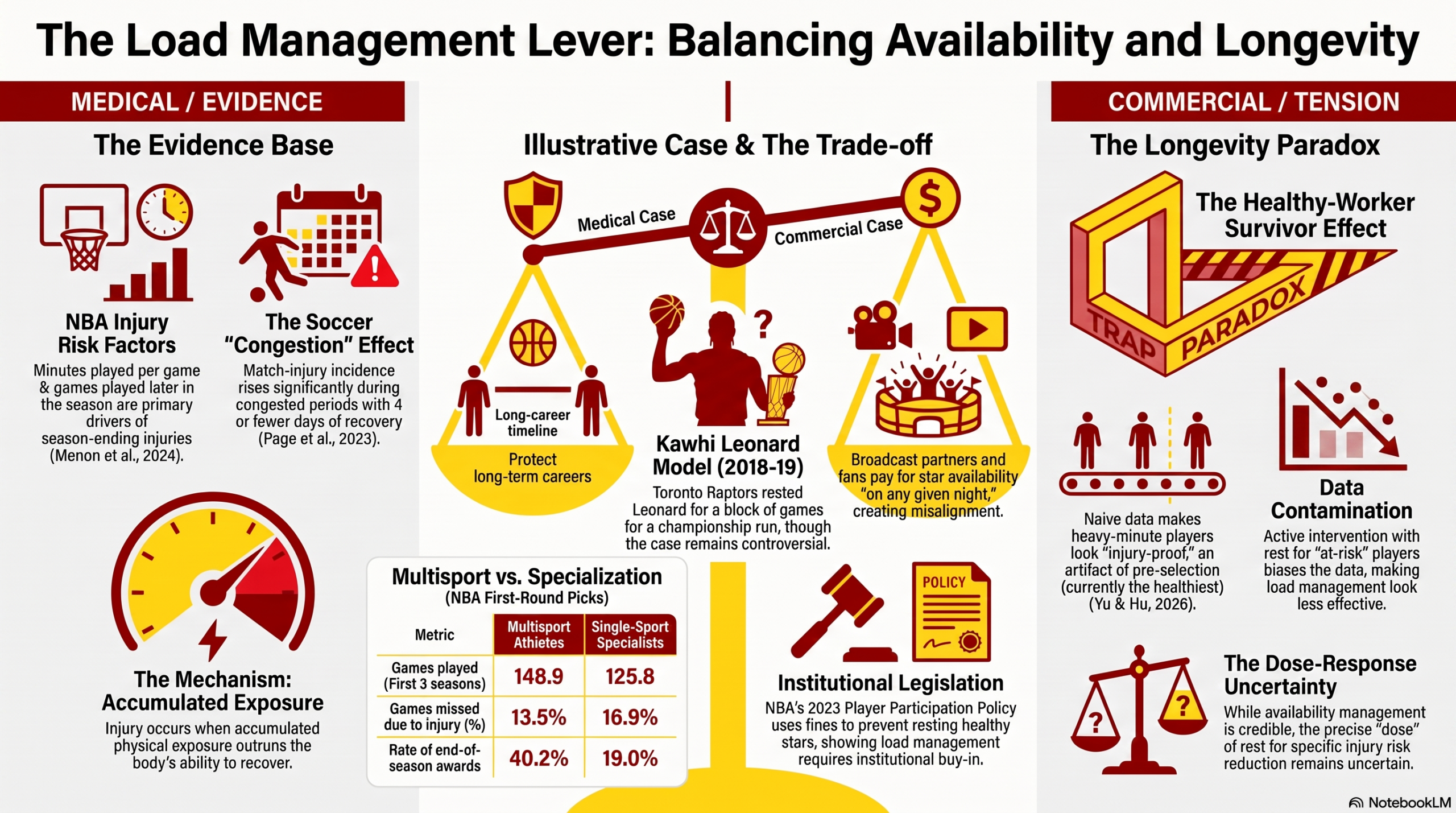
A caution follows immediately, and it applies to everything that comes after. The best longevity evidence is sport-specific and often league-specific, and it does not transfer cleanly. The basketball load-management research rests on the particular structure of an 82-game NBA season with its travel and density; the football age curves come from a different sport with different physical demands and a different competitive calendar. A finding that holds for an NBA guard is a hypothesis, not a conclusion, for a Premier League winger or a Test cricketer. This is the first discipline of thinking about longevity seriously: resist importing a number from the sport where it was measured into the sport where you happen to work.
The second discipline is to define the target before chasing it, because longevity is not one outcome but several, and they do not move together. Years under contract, games available, minutes at an elite standard, injury-free seasons, and performance relative to the age-and-position expectation are all things a department might mean by a longer career, and each points to a different intervention. Load management may raise playoff availability while lowering regular-season participation. A broad youth foundation may reduce early-career injuries without saying anything about output at 35. Age-curve modelling describes performance decline, not medical availability. A programme that has not said which of these it is optimising will end up buying tools that improve a number nobody was actually trying to move.
The load-management evidence: availability as the lever
The most concrete in-career lever is availability management: reducing the accumulation of exposures that plausibly raise injury risk. The clearest research base for it is in basketball, though it is worth stating up front that the evidence is strongest for injury and availability outcomes, not for career-length causality itself. A retrospective study of season-ending injuries in the NBA across the 2015 to 2020 seasons identified minutes played per game and games later in the season as the primary risk factors, reporting incidence per game exposure across six seasons (Menon et al., 2024). The logic that follows, and that the accompanying editorial commentary drew out explicitly, is that scheduled periods of rest are intended to reduce the physiological burden a player accumulates across a grueling season, and thereby lower the risk of the catastrophic injuries that end seasons and shorten careers (Jildeh, 2024).
The basketball evidence does not stand alone, which matters given the caution about transfer between sports. In football, a systematic review of fixture congestion in professional male soccer found that most included studies reported a higher match-injury incidence during congested periods, when players compete with four or fewer days of recovery between matches (Page et al., 2023). The mechanism is the one the basketball work points to, accumulated exposure outrunning recovery, arriving from a different sport with a different calendar, and that convergence makes the underlying principle more credible than either literature alone. The most cited individual example is the Toronto Raptors’ decision to rest Kawhi Leonard for a large block of regular-season games in the 2018-19 season, widely read afterwards as having preserved his availability for the playoff run that ended in the franchise’s first championship. The case is illustrative rather than evidential, and worth holding loosely: Leonard himself later said he had been injured throughout that season, which cuts against the clean narrative of strategic rest. It is instructive mainly because it exposes the trade-off rather than hiding it: load management can protect availability, but at a visible cost in regular-season participation that collides with competitive and commercial interests. The NBA’s subsequent Player Participation Policy, approved in 2023, which put stipulations and fines on resting healthy star players, is the institutional expression of exactly that tension (NBA, 2023), and it is why this is not a purely medical decision.
That tension is not a footnote; it is the central practical problem of load management as a longevity tool. The medical case and the commercial case point in opposite directions on any given night. A rested star protects a career and disappoints a sold-out arena and a broadcast partner who paid to show that player. The people who bear the cost of resting are different from those who capture the benefit three seasons later, and that misalignment is why the decision cannot be left to the medical staff alone and why leagues have had to legislate it.
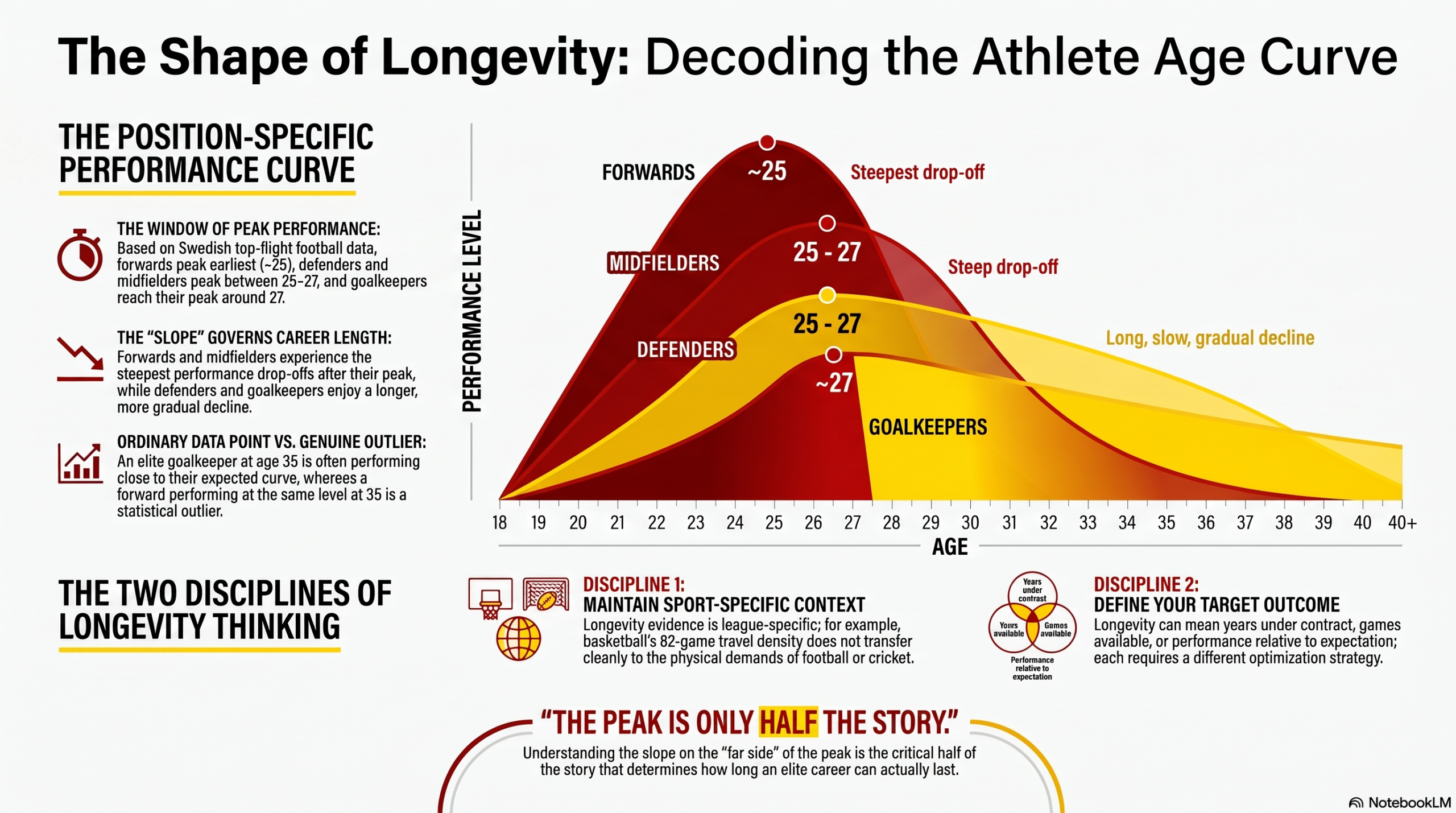
For a performance director, the implication is that a longevity strategy built on availability management is only as strong as the institutional agreement behind it. Without buy-in from the coach, the front office and, increasingly, the league, the medically optimal rest plan will lose to the commercially urgent line-up every time.
It is worth being precise about what the evidence does and does not establish, because this is where the category most often overreaches. The association between high cumulative load and season-ending injury is reasonably supported. The stronger causal claim, that a given pattern of rest reliably reduces injury risk at the individual level, is harder to establish cleanly, and a recent preprint makes the methodological problem explicit: teams actively intervene on the workload of the very players most at risk, which biases naive analyses in ways that can make load management look less effective than it is, an instance of what epidemiologists call the healthy-worker survivor effect (Yu & Hu, 2026). Availability management is a credible lever. The precise dose-response between rest and injury reduction remains an area of genuine uncertainty, and anyone who tells you otherwise is selling something.
The trap inverts a naive reading of the data. Model NBA game logs directly and heavy-minutes players can appear less injury-prone, which looks like proof that load is harmless. It is an artifact: those players are on the floor precisely because they are currently healthy enough to be, while the vulnerable have already been rested or removed, so the heavy-minutes sample is pre-selected for durability. Correcting for that selection can flip the sign of the effect. The practical lesson is uncomfortable: your own intervention on the most at-risk players contaminates the very data you would use to evaluate whether the intervention works. Longevity analytics is not just hard to measure, it is hard in a way that punishes the naive.
The early-foundations evidence: what athletes did before they were elite
A second, less obvious contributor to durability appears to be laid down long before an athlete reaches the elite level. A retrospective review of NBA first-round draft picks from 2013 to 2023 found that those who had been multisport athletes in high school were more resilient to workload than those who had specialised early in basketball alone. The multisport group played significantly more games in their first three seasons (148.9 versus 125.8), missed a significantly lower percentage of games to injury (13.5% versus 16.9%), and achieved markedly more, with higher player efficiency ratings and a far higher rate of end-of-season awards (40.2% versus 19.0%) (Sang et al., 2025). An earlier study of an older draft cohort had already pointed the same way, linking multisport backgrounds to fewer major injuries and longer careers (Rugg et al., 2018).
This points to a contributor to longevity that no in-career intervention can retrofit: the breadth of the athletic foundation built in youth. It aligns with a broader body of work cautioning against early single-sport specialisation, and it carries a blunt message for the development pathways that feed elite sport. But it is, by its nature, a lever that acts on the next generation of athletes rather than the current one. One of the most durable things a programme can do for longevity may be a decision made about fifteen-year-olds, whose effects will not show up in the senior squad for a decade. That is an uncomfortable timescale for an industry that measures itself in seasons.
What is plausible but not yet proven
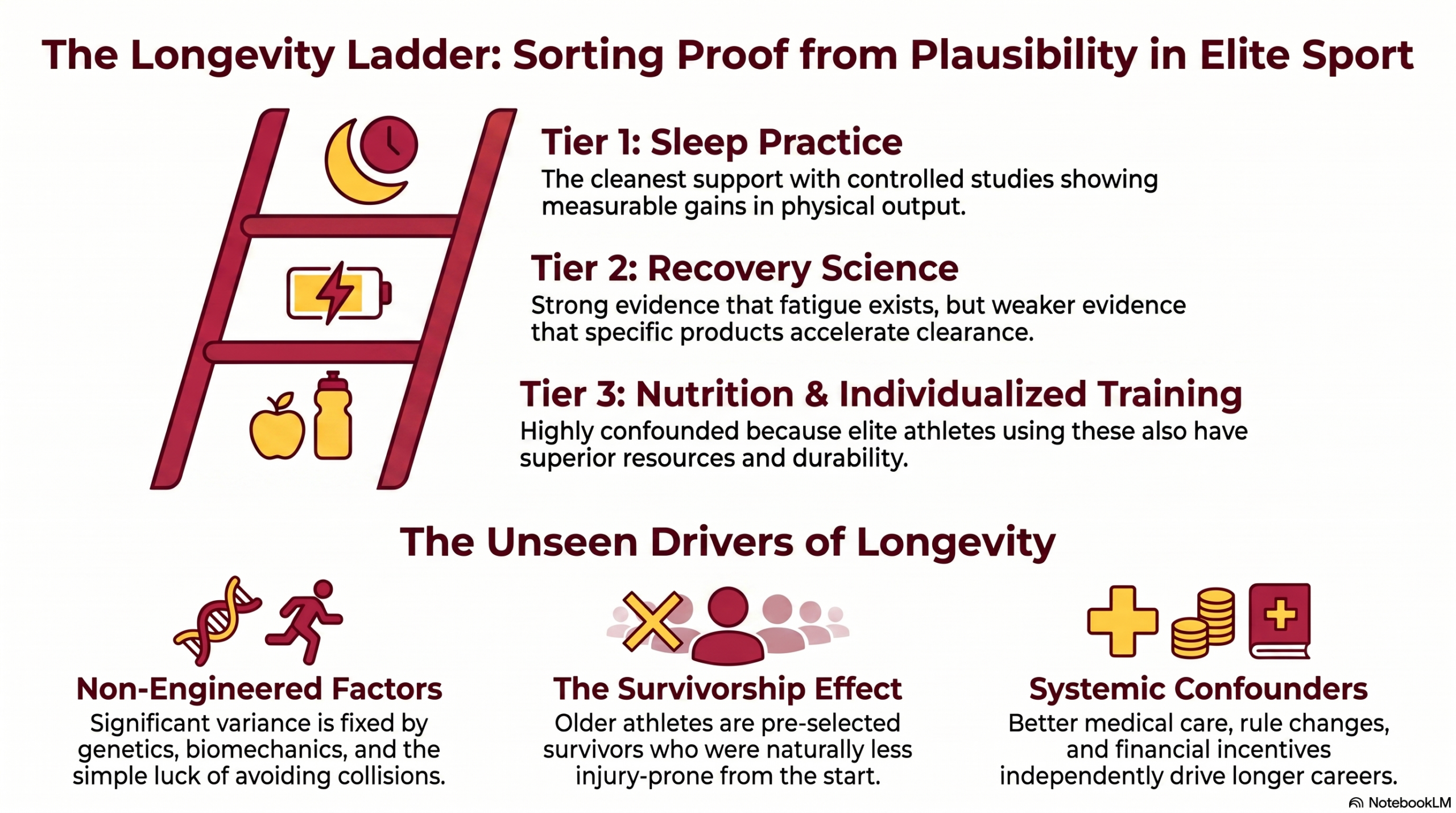
Beyond load management and early athletic foundation, a great deal of what gets credited with extending careers sits in the category of plausible but unproven, and intellectual honesty means keeping it there. Improvements in recovery science, nutrition, sleep practice and individualised training are all reasonable candidate contributors, and several have coherent mechanistic rationales that we have examined elsewhere in this series.
But the trend toward longer careers is confounded by many simultaneous changes: better medical care, larger support staffs, financial incentives that make extended careers more attractive, changes in playing style and rules, and survivorship effects baked into the data. Attributing the longevity trend to any single one of these, and particularly to whichever recovery technology a vendor happens to be selling, is exactly the kind of causal overreach this series consistently warns against.
The correlation between the rise of an intervention and the rise in career length is not evidence that the former caused the latter. A dozen things changed at once, and the technology is only the most visible, not necessarily the most important.
There is also a factor no programme designs and no vendor sells, and honesty requires naming it: a large share of longevity is simply not engineered. The athletes who compete at elite level into their mid-thirties are, in part, a selected population, survivors of an attrition that removed the more injury-prone before they arrived, endowed with connective tissue, recovery capacity and biomechanics they did not choose, and helped by the plain luck of avoiding the freak collision that ends careers regardless of preparation. This does not make the controllable levers worthless. It makes them levers on the margin around a large block of variance that is fixed, and a programme that forgets this will over-credit its own interventions when an athlete endures and blame them unfairly when one does not.
This is not a reason to dismiss those interventions, but it is a reason to rank them by the strength of their case rather than treating them as one bucket. Of the four, sleep has the cleanest support: controlled sleep-extension work has shown measurable gains in the physical outputs that fatigue degrades, which is closer to a causal chain than the others can claim. Recovery science sits a rung down, with strong evidence that fatigue is real and slower to clear than schedules assume, but weaker evidence that any specific recovery product accelerates it. Nutrition and individualised training are the most confounded, because the athletes who invest in them also tend to have the resources, staff and intrinsic durability that independently predict longer careers, which makes their association with longevity especially hard to read as cause. That ranking matters most when budgets are set, because a plausible contributor and a proven cause justify very different spending, and the marketing is designed to blur precisely that line.
The position a department can hold
Longevity is real, valuable, and partially controllable, but it is not a single thing with a single cause, and the departments most likely to extend their athletes’ careers are the ones that resist the simple narrative.
The position the evidence supports is this. Anchor longevity thinking to the position-specific age curve, because extending a career means deviating from an expected decline, and that expectation differs by role. Treat cumulative-load management as the most evidence-supported in-career lever, while staying honest that the precise relationship between rest and injury reduction is still contested. Recognise that some of the most powerful durability factors, a broad youth athletic foundation in particular, are laid down before the elite career begins and cannot be retrofitted, which makes them an argument about how development pathways are designed rather than a tool for the current squad. And hold the remaining candidates, recovery, nutrition, sleep, individualised training, as plausible contributors rather than proven causes. The athletes performing into their mid-thirties are not, in most cases, the product of a single breakthrough. They are the product of a durable foundation, careful availability management, good fortune in injury, and a set of marginal gains that are real but hard to isolate.
If that resolves into a short discipline for anyone designing a longevity programme, it is this. Name the endpoint first, because games available, minutes at elite standard, injury-free seasons and contract years are different targets. Fix the comparison, because still playing at 34 only means something against the curve for that sport and position. Sort the levers by when they act: the in-career ones, load, calendar, recovery, strength, sleep and travel, against the pre-career ones, a broad athletic foundation, that can only be built for the next generation. Be explicit about the evidence tier behind each, from association to causal inference to a club’s own longitudinal data. And name the trade-off out loud, because most longevity levers cost something today to buy availability tomorrow, and a plan that hides that cost will lose to the urgent line-up every time.
The department that understands longevity this way will make better decisions than the one hunting for the single intervention that explains it, because that intervention does not exist. The edge is not in finding the one lever. It is in pulling several honest ones at once, and in being clear-eyed about which are proven, which are plausible, and which were decided years before the athlete ever arrived.
How this series is made, and how to read it: this is editorial analysis, not a practitioner’s memoir and not a systematic review. PERFORM’s pieces are researched and drafted with the assistance of AI tools, then reviewed, edited and fact-checked by our editorial team against primary sources, peer-reviewed literature, clearly labelled preprints, industry reports, league and company announcements, and practitioners’ own published work. Where the evidence is strong we say so; where it is limited we treat it as limited; where a claim comes from a vendor or corporate announcement we treat it as a hypothesis, not proof. The views here are our editorial position, drawn from the published record rather than first-hand experience inside an elite performance department. Where practitioners are named or quoted, those words are their own. Where we couldn’t verify a claim, we left it out. And where you have the hands-on experience we’re writing about, we’d rather hear from you than pretend to it.
References
Jildeh, T. R. (2024). Editorial commentary: Load management is essential to prevent season-ending injuries in the National Basketball Association. Arthroscopy: The Journal of Arthroscopic and Related Surgery, 40(9), 2474–2476. https://doi.org/10.1016/j.arthro.2024.02.024
Menon, S., Morikawa, L., Tummala, S. V., Buckner-Petty, S., & Chhabra, A. (2024). The primary risk factors for season-ending injuries in professional basketball are minutes played per game and later season games. Arthroscopy: The Journal of Arthroscopic and Related Surgery, 40(9), 2468–2473. https://doi.org/10.1016/j.arthro.2024.01.018
NBA. (2023, September 13). NBA Board of Governors approves new Player Participation Policy. NBA Communications. https://pr.nba.com/nba-board-of-governors-approves-player-participation-policy/
Page, R. M., Field, A., Langley, B., Harper, L. D., & Julian, R. (2023). The effects of fixture congestion on injury in professional male soccer: A systematic review. Sports Medicine, 53(3), 667–685. https://doi.org/10.1007/s40279-022-01799-5
Rugg, C., Kadoor, A., Feeley, B. T., & Pandya, N. K. (2018). The effects of playing multiple high school sports on National Basketball Association players’ propensity for injury and athletic performance. American Journal of Sports Medicine, 46(2), 402–408. https://doi.org/10.1177/0363546517738736
Säfvenberg, R., Nordgaard, A., Lidmark Eriksson, O., Carlsson, N., & Lambrix, P. (2024). Age of peak performance among soccer players in Sweden. In Proceedings of the International Sports Analytics Conference and Exhibition (ISACE) 2024. Springer. https://doi.org/10.1007/978-3-031-69073-0_24
Sang, L., Bach, K., Feeley, B. T., & Pandya, N. K. (2025). Effects of early sport specialization on injury, load management, and athletic success of National Basketball Association players. Orthopaedic Journal of Sports Medicine, 13(1). https://doi.org/10.1177/23259671241304732
Yu, Y., & Hu, G. (2026). The load management paradox: Correcting the healthy-worker survivor effect in NBA injury modeling [Preprint]. arXiv. https://arxiv.org/abs/2603.26935