
The Warm-Up: The Routine Every Team Uses and Few Actually Test

This is part of our series on the science and technology shaping elite athlete performance in 2026. As ever, this is not a manual written from the touchline. It is a map of where the evidence is strong, where it is thin, and what a performance department should ask before letting any of it near a decision.
Few practices in elite sport are as universal as the warm-up. Yet for something so routine, it may also be one of the least routinely validated. Most protocols are inherited, adjusted by feel, and rarely tested against the outcomes they are supposed to produce. This article looks at what the evidence actually supports, which turns out to be more specific, and more valuable, than the ritual most teams perform.
The gap between belief and evidence
Coaches overwhelmingly believe warm-ups matter. That belief is reasonable and largely correct, but belief is not the same as validation. A warm-up can feel effective, follow tradition, and still not be doing what the team assumes it does. Because warm-ups are rarely formally tested against measured outcomes within a specific team, most squads are running a protocol whose actual effect on their own athletes is unknown. The routine is treated as self-evidently beneficial, which is exactly the condition under which unexamined practice persists.
This matters because the warm-up is not a neutral activity. It consumes time and energy before the main session, and a poorly designed one can fatigue athletes or fail to prepare them for the specific demands ahead. The question is not whether to warm up; clearly, teams should. It is whether the specific protocol a team uses delivers the preparation and protection it is assumed to.
Where the evidence is genuinely strong: structured injury-prevention warm-ups
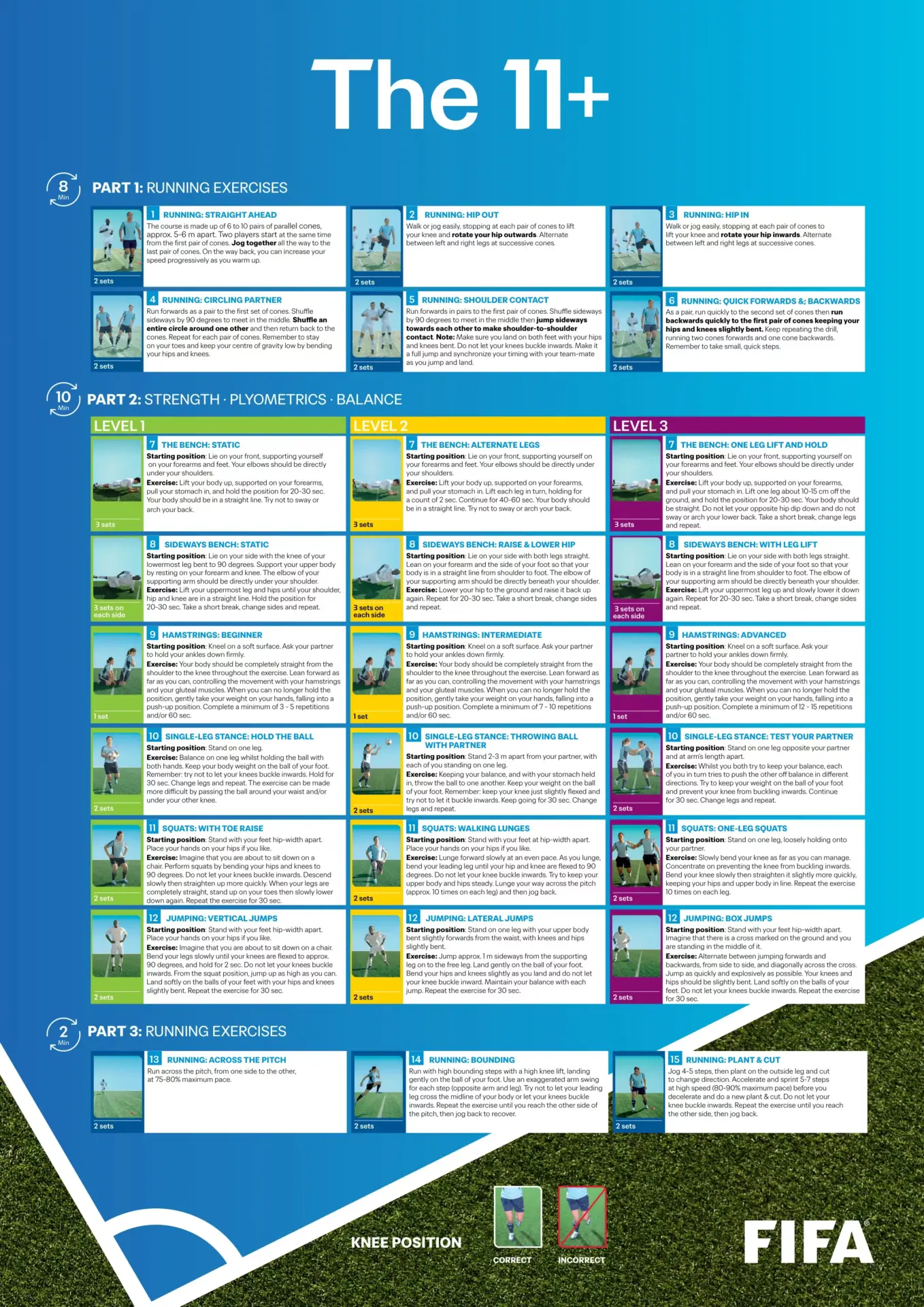
The clearest and most valuable evidence in this area concerns structured neuromuscular warm-up programs, and the best-studied example is the FIFA 11+. This is a roughly 20-minute warm-up combining running, strength, balance and plyometric exercises, designed specifically to reduce injury risk. Unlike most warm-ups, it has been tested extensively in randomized controlled trials, and the results are unusually strong for an applied, low-cost intervention (To see the FIFA 11+ Injury prevention and health promotion program, click here). The evidence is substantial. A systematic review and meta-analysis of randomized trials found that the FIFA 11+ reduced overall football injury incidence by approximately 39% relative to control warm-ups, though the evidence came predominantly from recreational and subelite populations (Thorborg et al., 2017).
Source: https://inside.fifa.com/
A more recent review of controlled trials found reductions ranging from roughly 30% to 46%, while also flagging heterogeneity in injury definitions, exposure reporting and adherence (Patel & Shah, 2025). The foundational trial behind this literature was a cluster-randomized study of 1,892 female youth footballers, which found a 32% lower risk of overall injury in the intervention group (Soligard et al., 2008), and a meta-analysis focused specifically on head and neck injuries, including concussion, found a 40% reduction per 1,000 hours of exposure (Al Attar et al., 2024).
The proposed mechanism is coherent with the program design rather than fully isolated by the trials: better neuromuscular control, trunk and hip stability, eccentric strength and dynamic alignment may reduce exposure to high-risk positions during cutting, landing and deceleration, the moments where injuries occur. This is a warm-up that has earned its place through evidence, not tradition.
An honest caveat about the evidence base
There is a limitation a high-performance audience has to hold clearly, because it is easy to overlook in the strength of the headline numbers. Almost all of the strongest FIFA 11+ evidence comes from youth, amateur and collegiate populations, not from elite senior professionals. The foundational trial was in adolescent girls (Soligard et al., 2008); the head-and-neck meta-analysis draws heavily on the 11+ and 11+ Kids programs in young players (Al Attar et al., 2024). This is not a flaw in the research; it is where randomized trials are easiest to run. But it means the direct read-across to a thirty-year-old professional is an inference rather than a demonstration. The underlying rationale, better neuromuscular control during high-risk movements, is not inherently age-specific and is likely to transfer, but the magnitude of benefit may not. The precise effect size at elite senior level, where baseline conditioning, medical support and movement quality are already high, is genuinely less certain, and a department should treat the headline percentages as evidence of direction rather than a guaranteed dividend for its own squad.
The complication: compliance and acute readiness
There are two honest caveats that keep this from being a simple recommendation. The first is compliance. Structured programs like the FIFA 11+ deliver their full protective effect only when performed consistently and correctly, and real-world adherence is frequently poor. A program that works in a trial delivers a fraction of its benefit in practice if players skip components, rush through it, or drop it once the novelty fades. Across the evidence base, greater adherence has generally been associated with stronger preventive effects, although implementation varies considerably between teams (Soligard et al., 2008; Thorborg et al., 2017). The evidence for the program is strong; the evidence that teams actually run it as designed is much weaker.
The second caveat concerns acute readiness, and it is more subtle than it is often made to sound. A warm-up designed primarily for injury prevention is not necessarily identical in emphasis to one designed to maximize immediate sprint or power output. But the FIFA 11+ should not be assumed to blunt performance: acute testing of the program has generally found neutral or positive effects across several physical qualities, including sprint, agility, jump and balance, with responses varying by outcome (Bizzini et al., 2013). The practical question is therefore not whether prevention and performance are inherently opposed, but whether the sequence, volume and final high-intensity phase of the protocol match the demands of the session or competition that follows.
Source: https://inside.fifa.com/
The emerging frontier: priming and cognitive readiness
Beyond injury prevention, two more speculative but interesting areas are developing. The first is physical priming, using a high-intensity conditioning activity in the warm-up to enhance subsequent explosive output, commonly described as post-activation performance enhancement. Meta-analytic evidence suggests that small acute improvements in jump and sprint performance are possible, particularly after resistance-based conditioning activities, but the response depends heavily on the exercise, the recovery interval, the athlete’s training status and the quality of the comparison warm-up, and the pooled certainty remains low (Xu et al., 2025). The effect is credible; the prescription remains highly individual, which makes testing it on your own athletes more defensible than adopting a universal protocol.
The second, and newer, is cognitive priming, the idea that including cognitive challenge in the warm-up may improve subsequent decision-making, particularly when athletes are fatigued. A small 2025 study in padel players found that adding short-to-medium cognitive tasks to a physical warm-up improved subsequent sport and cognitive performance in both rested and sleep-restricted conditions, a Goldilocks effect in which the dose had to be neither too little nor too much (Díaz-García et al., 2025). That is an interesting signal, not yet a general protocol for elite teams, and the evidence base should be treated as promising rather than established.
The position a department can hold
The warm-up is ubiquitous, consequential, and strikingly under-examined. The opportunity is not to abandon it but to hold it to the same evidential standard as any other performance practice.
That points to a simple operating test, and it is the practical core of this piece. A warm-up should be judged against four questions: what outcome is it actually designed to change, injury risk, physical readiness, or specific preparation; what dose that outcome requires; what acute cost it imposes on the session that follows; and how the department will know whether it worked. Most inherited protocols have never been asked the first question, let alone the fourth.
The position the evidence supports is this. Recognize that most warm-up protocols are inherited rather than validated, and that a routine feeling effective is not evidence that it is. Adopt structured neuromuscular injury-prevention warm-ups such as the FIFA 11+, which have strong randomized-trial evidence for reducing injury, while being clear-eyed that most of that evidence sits in youth, recreational and subelite populations and transfers to elite seniors as a well-founded inference rather than a proven number. Treat compliance as the implementation challenge, because partial or inconsistent execution is unlikely to deliver the full benefit. Do not assume that injury prevention and immediate readiness are inherently opposed, but adapt the sequence, volume and final high-intensity exposure to whether the warm-up precedes training or competition. And watch the emerging priming and cognitive-readiness research as promising rather than proven. The warm-up is one of the most-performed and least internally tested routines in sport, and evaluating it against the team’s own injury and performance outcomes is one of the cheaper edges available.
How this series is made, and how to read it: this is editorial analysis, not a practitioner’s memoir and not a systematic review. PERFORM’s pieces are researched and drafted with the assistance of AI tools, then reviewed, edited and fact-checked by our editorial team against primary sources, peer-reviewed literature, clearly labelled preprints, industry reports, league and company announcements, and practitioners’ own published work. Where the evidence is strong we say so; where it is limited we treat it as limited; where a claim comes from a vendor or corporate announcement we treat it as a hypothesis, not proof. The views here are our editorial position, drawn from the published record rather than first-hand experience inside an elite performance department. Where practitioners are named or quoted, those words are their own. Where we couldn’t verify a claim, we left it out. And where you have the hands-on experience we’re writing about, we’d rather hear from you than pretend to it.
References
Al Attar, W. S. A., Majrashi, A., & Bizzini, M. (2024). Effectiveness of FIFA 11+ injury prevention programs in reducing head and neck injuries, including concussion, among soccer players: A systematic review and meta-analysis. Pediatric Exercise Science, 37(4), 403–412. https://doi.org/10.1123/pes.2023-0187
Bizzini, M., Impellizzeri, F. M., Dvorak, J., Bortolan, L., Schena, F., Modena, R., & Junge, A. (2013). Physiological and performance responses to the “FIFA 11+” (part 1): Is it an appropriate warm-up? Journal of Sports Sciences, 31(13), 1481–1490. https://doi.org/10.1080/02640414.2013.802922
Díaz-García, J., Rubio-Morales, A., Manzano-Rodríguez, D., García-Calvo, T., & Ring, C. (2025). Cognitive priming during warmup enhances sport and exercise performance: A Goldilocks effect. Brain Sciences, 15(3), 235. https://doi.org/10.3390/brainsci15030235
Patel, P., & Shah, M. (2025). The impact of the FIFA 11+ injury prevention program on injury incidence in football athletes: A systematic review of randomized controlled trials. Cureus, 17(12), e100463. https://doi.org/10.7759/cureus.100463
Soligard, T., Myklebust, G., Steffen, K., Holme, I., Silvers, H., Bizzini, M., Junge, A., Dvorak, J., Bahr, R., & Andersen, T. E. (2008). Comprehensive warm-up programme to prevent injuries in young female footballers: Cluster randomised controlled trial. BMJ, 337, a2469. https://doi.org/10.1136/bmj.a2469
Thorborg, K., Krommes, K. K., Esteve, E., Clausen, M. B., Bartels, E. M., & Rathleff, M. S. (2017). Effect of specific exercise-based football injury prevention programmes on the overall injury rate in football: A systematic review and meta-analysis of the FIFA 11 and 11+ programmes. British Journal of Sports Medicine, 51(7), 562–571. https://doi.org/10.1136/bjsports-2016-097066
Xu, K., Blazevich, A. J., Boullosa, D., Ramirez-Campillo, R., Yin, M., Zhong, Y., Tian, Y., Finlay, M., Byrne, P. J., Cuenca-Fernández, F., & Wang, R. (2025). Optimizing post-activation performance enhancement in athletic tasks: A systematic review with meta-analysis for prescription variables and research methods. Sports Medicine, 55(4), 977–1008. https://doi.org/10.1007/s40279-024-02170-6