
Wearables in Elite Sport: The Sensor War Is Over, the Interpretation War Has Just Begun
Prefer listening? Play the audio version:
This is the second deep dive in our series on the technologies actually changing elite sport in 2026. Each deep-dive takes one area, names the platforms, and reads the evidence honestly, separating what the published record supports from what the marketing claims. This is not a manual written from the touchline; it is a map of where the evidence is strong, where it is thin, and what a performance department should ask before letting any of it near a decision.
There is a particular conversation that happens in performance departments when the new devices land and someone has to decide what to buy. It used to be about hardware: which GPS vest, which strap, which ring. That conversation is largely over, and the honest answer is that it matters less than the vendors would like. For the mature metrics many elite departments rely on every day, the hardware is often good enough to be useful. But good enough to measure is not the same as good enough to decide. The serious question in 2026 is no longer only whether a wearable measures something accurately. It is whether anyone in the building can turn what it measures into a decision worth making, and whether the newest, most expensive frontier in the category, biochemical monitoring, closes that gap or just relocates it somewhere more costly and more authoritative.
This piece makes one argument in three parts. First, that for many mature, everyday metrics (team-sport GPS as much as sleep and heart rate) the hardware is often good enough to be useful. Second, that the unsolved problem was never measurement but interpretation, and the industry has papered over that with composite scores that look like answers and have never been formally validated. Third, that the move into biochemical monitoring, blood panels from WHOOP and the more genuinely novel frontier of non-invasive sweat lactate, is the same interpretation problem one storey up, where the numbers carry more authority and the cost of misreading them is higher.
Part one: the sensor war is over for mature metrics
“The sensor war is over” is too neat a phrase, and it is worth saying why before leaning on it. Anyone who has tried to pull clean GPS data indoors, or trusted a non-invasive lactate reading mid-session, will tell you the hardware still has limits. But for the core metrics an elite department actually uses (external load from GPS, heart rate, sleep), the validation literature has matured enough to be specific about what the devices do well and what they do not.
Start with team-sport GPS, because it is the wearable most professional clubs genuinely live on. The independent validation here is reassuring on the headline metrics: the STATSports Apex 10 Hz unit shows distance errors of roughly 1–2% against criterion measurement, with peak-speed bias in a similar range (Beato et al., 2018), and the Catapult Vector S8 shows good concurrent validity against VICON motion capture and radar, with minimal error for distance and speed (Ellens et al., 2025). The catch, and any practitioner who has run a squad’s GPS programme knows this, is between-unit and between-brand reliability. Errors grow with rapid changes of direction and acceleration, processing methods differ between manufacturers, and you cannot mix a player’s 10 Hz unit one week with an 18 Hz unit the next, or compare your distances against another club’s, without introducing noise that swamps the signal (Thornton et al., 2019). The hardware is accurate; the discipline of keeping the same athlete in the same unit and processing it the same way is where programmes quietly fall down. The deeper point is that GPS validity is not a property of the device. It is a property of the device, the metric, the movement pattern, the environment, the processing method and the decision threshold, all at once. The useful question is never “is Catapult valid?” but “valid for which metric, in what context, for what decision?”
Sleep tells a similar story. A 2024 validation from Brigham and Women’s Hospital compared three consumer devices against gold-standard polysomnography (Robbins et al., 2024), and the broader literature is consistent: research-grade consumer devices detect sleep-versus-wake with high accuracy (around 96% for two-stage classification in the Ōura ring) but their ability to classify sleep stages (light, deep, REM) drops to roughly 79% (Altini & Kinnunen, 2021).
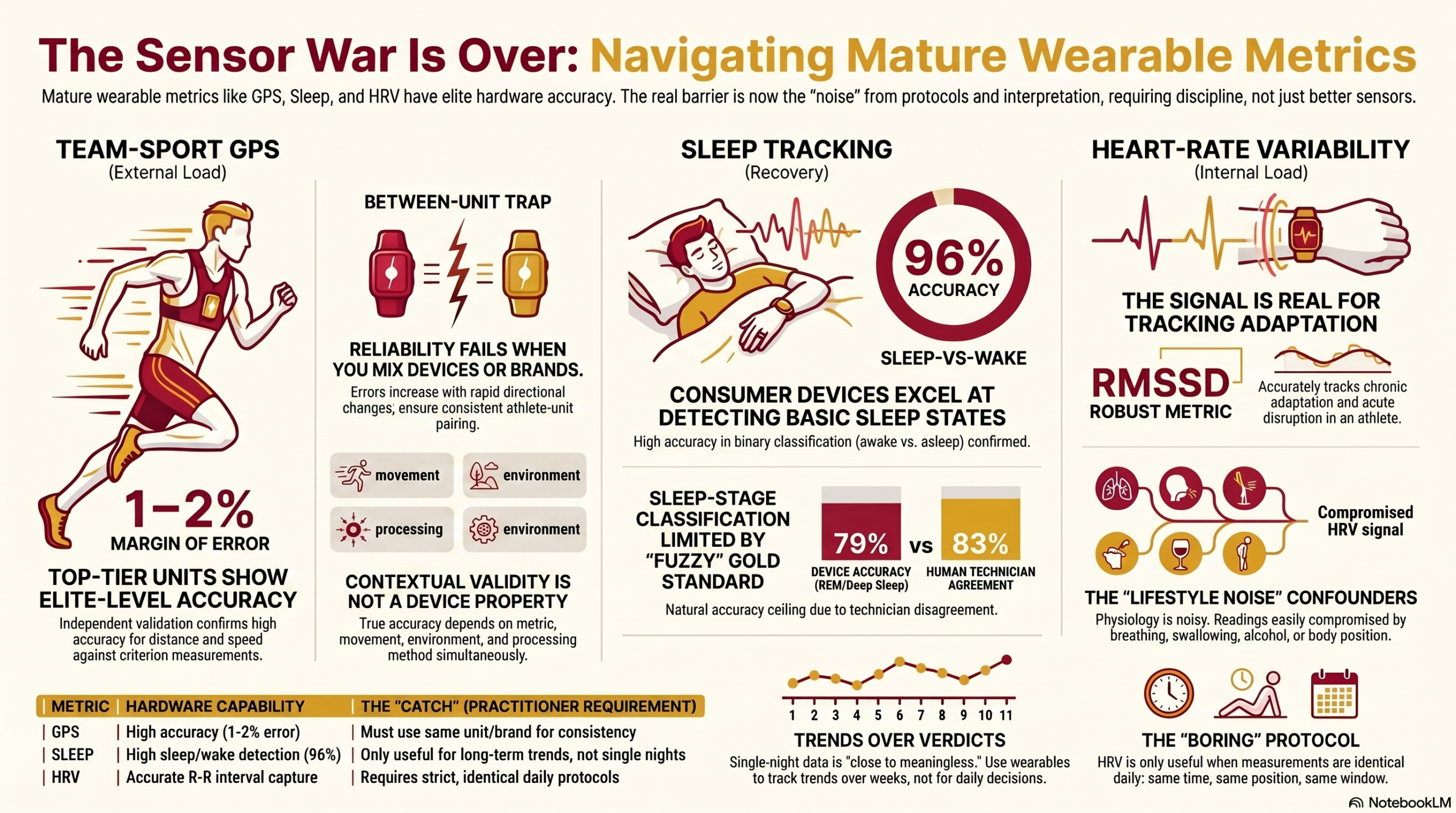
Here is the detail that should reframe how a practitioner reads that second number: 79% is close to the ceiling, because human polysomnography technicians scoring the same night agree with each other only about 83% of the time. The device is not failing against a perfect standard; the standard itself is fuzzy. But that cuts the other way from how it sounds: it does not make four-stage sleep output decision-grade, it means the benchmark itself is noisy, so single-night sleep-stage data should be treated with more caution, not less. Useful for tracking trends over weeks; close to meaningless as a single-night verdict, which is exactly how the dashboards present it.
Heart-rate variability is where the gap between what the sensor can do and what the score claims is widest. A December 2025 narrative review in Sensors makes the constructive case (Esco et al., 2026): read as a rolling average with attention to its coefficient of variation, RMSSD, the most robust practical HRV metric, can track both chronic adaptation and acute disruption. The signal is real. But the same review is candid about the confounders: HRV shifts with measurement position, breathing, recording time, alcohol, even swallowing during a reading. The device can capture the R-R interval accurately and the number can still mislead you, because the underlying physiology is genuinely noisy. HRV only becomes useful when the protocol is boring: same time, same position, same context, same interpretation window. Without that discipline you do not have HRV; you have lifestyle noise with a decimal point. A clean signal is not the same as a meaningful one, and that is the bridge to the real problem.
Part two: the interpretation problem nobody is selling
Here is the uncomfortable truth about the “readiness” score on the front of every wearable app: it has never been formally validated. That is not editorialising; it is the conclusion of a living umbrella review of consumer-wearable accuracy in Sports Medicine, which notes that the bespoke composite scores from Fitbit, Garmin, Oura and WHOOP (readiness, recovery, strain, body battery) collate multiple signals into a single number, yet “none have undergone formal validation” (Doherty et al., 2024). The Gatorade Sports Science Institute reaches the same place from the applied side: there is no objective way to quantify constructs like readiness, recovery or sleep quality, and practitioners should be sceptical of single scores that blend physiology and behaviour, what GSSI bluntly calls “made-up scores” (Gatorade Sports Science Institute, 2024).
This is the heart of the matter. The hardware measures real signals; the scores layered on top fold physiology, behaviour and proprietary assumption into one number. A low readiness score might reflect genuinely suppressed HRV, or an assumption the algorithm makes about your behaviour, and the two demand opposite responses. Steve Ingham, the performance scientist who spent three decades in Olympic and professional sport, sorts wearable outputs into a hierarchy of trust (Ingham, 2025): measured basics like resting heart rate and sleep timing at the top, derived training metrics in the middle, and composite “readiness,” “stress” and “body battery” scores at the bottom, to be treated, in his words, “as noise unless they consistently align with your lived experience.”
His framing of the whole category is the right one for a performance department: “the aim is to use wearables to support better decisions, not to become a hostage to the graph.”
The failure mode this produces in elite environments is familiar to anyone who has run a monitoring programme. An athlete sees a low score and arrives anxious; or sees a high score and overrides how they actually feel; or staff lose confidence in a number that swings for reasons no one can explain on a given morning, and the programme decays into a compliance exercise. The technology did not fail. The interpretation layer was never built. The clubs that get genuine value from wearables are, almost without exception, the ones where a specific person’s job is to translate device output into a coaching or medical decision: someone who knows the athlete’s baseline, the measure’s noise, and the smallest change worth acting on. Where that person does not exist, the most accurate sensor in the world produces an expensive dashboard nobody opens.
Part three: biochemical monitoring, or the interpretation problem one storey up
The most interesting development in the category in 2026 is the move from what a sensor infers through the skin to what chemistry can measure directly, and it is splitting into two very different paths. The louder one is blood. In September 2025 WHOOP launched Advanced Labs, a clinician-reviewed blood-testing service through Quest Diagnostics pairing a 65-biomarker panel with the wrist strap’s continuous data (WHOOP, 2025a); by April 2026 it had added five Specialized Panels of 75–89 biomarkers each at USD 299 apiece (WHOOP, 2026), and other consumer-wearable companies, Oura among them, are moving the same way, pairing continuous wearable data with periodic biomarker testing. The logic is genuinely compelling: a wearable infers, a blood test measures; put a ferritin or hormonal panel next to months of sleep and load data and you have something closer to a real physiological picture than either gives alone.
But the same problem from part two is sitting there, one storey up, and WHOOP’s own data shows it. The company reported that even among its highly active user base, 22% showed signs of metabolic dysfunction and nearly 30% had cardiometabolic risk factors, often without prior awareness (WHOOP, 2026). That is not elite-sport evidence; it is a consumer-health signal from a large, self-selected user base, and its value here is as a warning about interpretation, not as a guide to athlete management.
Read one way, it is powerful early detection. Read another, it is exactly the interpretation trap: reference ranges are built on general populations, not elite athletes, whose values routinely sit outside “normal” for reasons that have nothing to do with ill health.
A single draw is a snapshot of a system in constant flux. Sorting a result into “optimal,” “sufficient” or “out of range” is itself an interpretive act carrying every one of the hidden assumptions of a readiness score, now wearing a lab coat, and harder to argue with precisely because blood feels authoritative. The interpretation problem does not shrink when you move from an optical sensor to a venous draw. It grows, because the cost of over-reacting to an out-of-context number is higher. And it stops being only an interpretation problem. In elite settings, blood data should sit under medical governance, not performance curiosity: the question is not only what a panel shows, but who is allowed to interpret it, who sees it, how it is stored, what consent it rests on, and what happens when it reveals something unrelated to performance. A sports scientist reading a hormonal or cardiometabolic panel like another dashboard is a scope-of-practice problem before it is an analytical one.
The quieter path is the one that should interest an elite endurance department more: non-invasive, continuous sweat biochemistry. Real-time sweat lactate sensors now cover the physiological range and aim to track lactate thresholds and training zones without a finger-prick (Yang et al., 2024), and a fully integrated system has undergone analytical validation and on-body testing in elite cyclists and kayakers, with sub-90-second response times and meaningful correlations against blood lactate, power output and heart rate (Xuan et al., 2023).
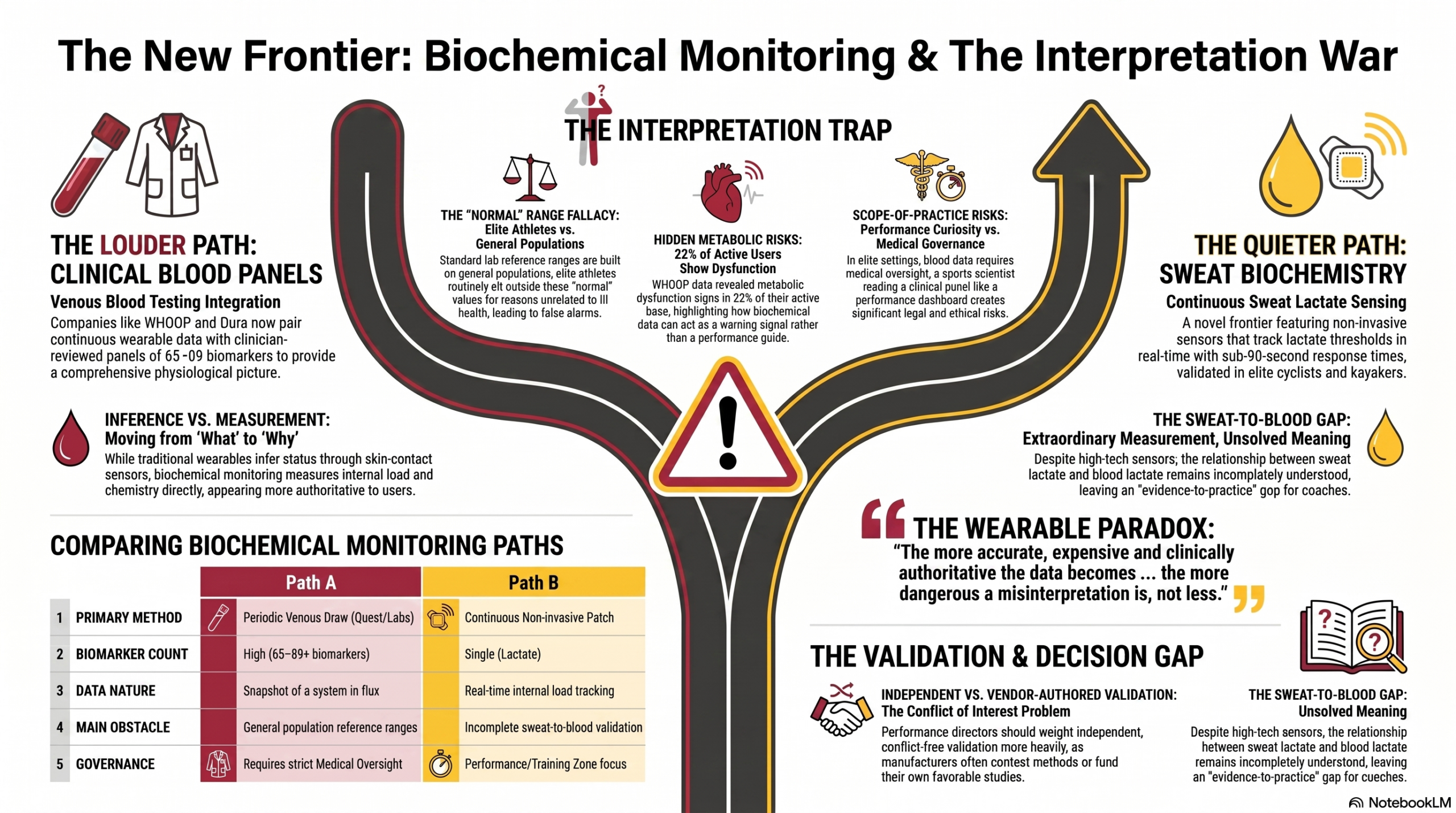
This may be the most novel measurement frontier in endurance sport, continuous internal-load data that until now required stopping to draw blood, but novelty is not the same as decision-readiness, and this is where the evidence-to-practice gap remains especially wide. Even the honest reviews flag an incomplete understanding of the sweat-to-blood relationship and limited sport-specific validation. The measurement is becoming extraordinary. The interpretation, what a given sweat-lactate curve means for this athlete on this day in this sport, is exactly as unsolved as it was for the readiness score.
And underneath all of it sits the question that should govern the whole category: who is doing the validating. The cleanest illustration is a 2025 exchange in Physiological Reports. An independent group validated nocturnal resting heart rate and HRV across five wearables against an ECG reference over 536 nights, finding Oura most accurate and WHOOP moderately so (Dial et al., 2025). WHOOP published a formal reply arguing the comparison needed “contextual equivalence,” a technically reasonable point, written by two members of its own performance and data-science teams, who disclosed the conflict (Grosicki & Presby, 2025). None of this is scandal; manufacturers hold deep expertise and have every right to contest methods. It is simply why a performance director should weight independent, conflict-free validation more heavily than vendor-funded or vendor-authored work, and notice that even the widely cited sleep-staging accuracy figures originate from research conducted by the device maker’s own scientists. In the biomarker era, where the studies are thinner and more commercially entangled, that discipline matters more, not less.
The wearable paradox, and what it means for a performance department
If one thread runs through all three parts, it is that the binding constraint stopped being the sensor years ago and is now, and will remain, interpretation. But wearables carry a paradox worth naming on its own terms, because it is specific to this category and it cuts against intuition. The more accurate, expensive and clinically authoritative the data becomes, from a wrist sensor to a readiness score to a venous blood panel, the more dangerous a misinterpretation is, not less. A wrong GPS reading costs you a training insight. A misread blood biomarker, dressed in the authority of a lab result and a clinician’s review, can change how you manage an athlete’s health. Authority and risk rise together. The safeguard does not come bundled with the device.
That points to a few positions a serious department can hold. Buy hardware on the independent validation of the specific metrics you will actually use, and keep each athlete in the same unit, processed the same way, because between-unit drift will cost you more than brand choice ever will. Treat every composite score as a prompt to look, never a verdict to act on, and remember that none of them has been formally validated. Before investing in blood panels, ask who on staff will interpret values for an elite population whose “normal” is not the reference range’s normal, and what decision will actually change as a result. Watch sweat-lactate sensing closely if you work in endurance sport; it may be the most novel measurement frontier on the horizon, and still one of the least understood. And weigh all of it against the next-best use of the same money, because in most departments a second practitioner who can interpret the data you already collect will beat another stream of data nobody has time to read.
The wearable did its job a decade ago: it made the invisible measurable. The next decade of value will not come from measuring more, or from measuring more invasively. It will come from the less glamorous work of deciding what any of it means, and being honest, as the better practitioners already are, about how often the honest answer is “we don’t yet know.”
How this series is made, and how to read it: this is editorial analysis, not a practitioner’s memoir and not a systematic review. PERFORM’s pieces are researched and drafted with the assistance of AI tools, then reviewed, edited and fact-checked by our editorial team against primary sources – peer-reviewed literature, clearly labelled preprints, industry reports, league and company announcements, and practitioners’ own published work. Where the evidence is strong we say so; where it is limited we treat it as limited; where a claim comes from a vendor or corporate announcement we treat it as a hypothesis, not proof. The views here are our editorial position, drawn from the published record rather than first-hand experience inside an elite performance department. Where practitioners are named or quoted, those words are their own. Where we couldn’t verify a claim, we left it out. And where you have the hands-on experience we’re writing about, we’d rather hear from you than pretend to it.
References
Altini, M., & Kinnunen, H. (2021). The promise of sleep: A multi-sensor approach for accurate sleep stage detection using the Oura Ring. Sensors, 21(13), 4302. https://doi.org/10.3390/s21134302
Beato, M., Coratella, G., Stiff, A., & Iacono, A. D. (2018). The validity and between-unit variability of GNSS units (STATSports Apex 10 and 18 Hz) for measuring distance and peak speed in team sports. Frontiers in Physiology, 9, 1288. https://doi.org/10.3389/fphys.2018.01288
Dial, M. B., Hollander, M. E., Vatne, E. A., Emerson, A. M., Edwards, N. A., & Hagen, J. A. (2025). Validation of nocturnal resting heart rate and heart rate variability in consumer wearables. Physiological Reports, 13(16), e70527. https://doi.org/10.14814/phy2.70527
Doherty, C., Baldwin, M., Keogh, A., Caulfield, B., & Argent, R. (2024). Keeping pace with wearables: A living umbrella review of systematic reviews evaluating the accuracy of consumer wearable technologies in health measurement. Sports Medicine, 54(11), 2907–2926. https://doi.org/10.1007/s40279-024-02077-2
Ellens, S., Moran, C., & Varley, M. C. (2025). Concurrent validity and between-device reliability of the Catapult Vector S8 GNSS device. PLOS ONE, 20(10), e0333792. https://doi.org/10.1371/journal.pone.0333792
Esco, M. R., Fields, A. D., Mohammadnabi, M. A., & Kliszczewicz, B. M. (2026). Monitoring training adaptation and recovery status in athletes using heart rate variability via mobile devices: A narrative review. Sensors, 26(1), 3. https://doi.org/10.3390/s26010003
Gatorade Sports Science Institute. (2024). Making sense of wearables data (Sports Science Exchange No. 250). https://www.gssiweb.org/en/sports-science-exchange/Article/making-sense-of-wearables-data
Grosicki, G. J., & Presby, D. M. (2025). Accurate comparison of wearables requires contextual equivalence. Physiological Reports, 13(23), e70710. https://doi.org/10.14814/phy2.70710
Ingham, S. (2025). How to read your wearable: A scientist’s hierarchy of trust for health and performance data. drsteveingham.com. https://drsteveingham.com/how-to-read-your-wearable-a-scientists-hierarchy-of-trust-for-health-and-performance-data/
Robbins, R., Weaver, M. D., Sullivan, J. P., Quan, S. F., Gilmore, K., Shaw, S., Benz, A., Qadri, S., Barger, L. K., Czeisler, C. A., & Duffy, J. F. (2024). Accuracy of three commercial wearable devices for sleep tracking in healthy adults. Sensors, 24(20), 6532. https://doi.org/10.3390/s24206532
Thornton, H. R., Nelson, A. R., Delaney, J. A., Serpiello, F. R., & Duthie, G. M. (2019). Interunit reliability and effect of data-processing methods of global positioning systems. International Journal of Sports Physiology and Performance, 14(4), 432–438. https://doi.org/10.1123/ijspp.2018-0273
WHOOP. (2025a, September 30). WHOOP launches clinician-reviewed Advanced Labs [Press release]. https://www.whoop.com/us/en/press-center/whoop-launches-clinician-reviewed-advanced-labs/
WHOOP. (2026, April 16). WHOOP launches Specialized Panels to deliver deeper, more personalized health insights [Press release]. https://www.whoop.com/us/en/press-center/whoop-launches-specialized-panels-to-deliver-deeper-more-personalized-health-insights/
Xuan, X., Chen, C., Molinero-Fernández, A., Ekelund, E., Cardinale, D., Swarén, M., Wedholm, L., Cuartero, M., & Crespo, G. A. (2023). Fully integrated wearable device for continuous sweat lactate monitoring in sports. ACS Sensors, 8(6), 2401–2409. https://doi.org/10.1021/acssensors.3c00708
Yang, G., Hong, J., & Park, S.-B. (2024). Wearable device for continuous sweat lactate monitoring in sports: A narrative review. Frontiers in Physiology, 15, 1376801. https://doi.org/10.3389/fphys.2024.1376801